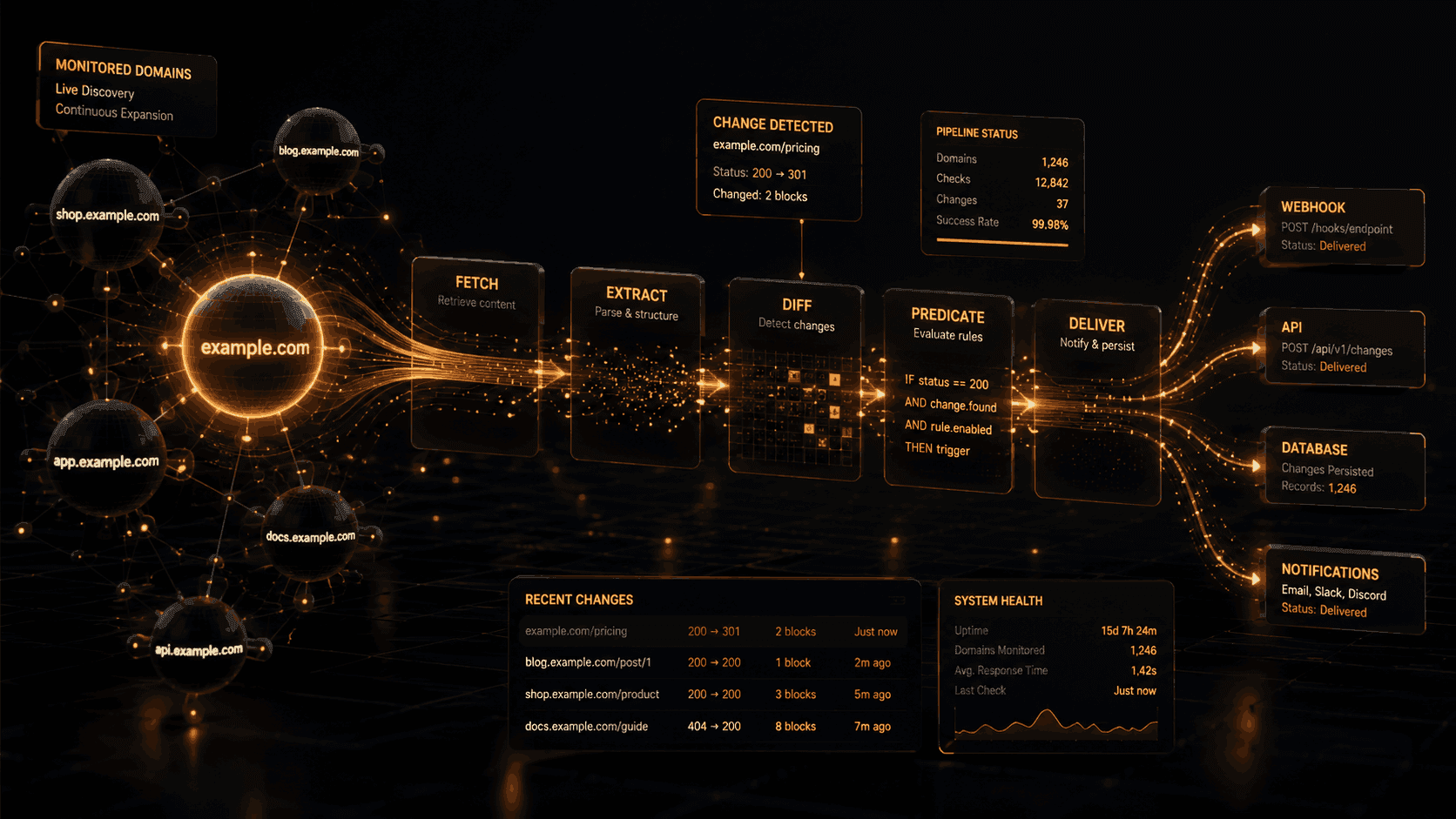
Domain Monitoring: The Developer's Complete Guide
What Is Domain Monitoring?
Domain monitoring is the practice of continuously watching a URL, API endpoint, or web resource for meaningful changes and triggering automated alerts when those changes occur. At its simplest, it answers one question: did something I care about change?
That definition sounds straightforward, but the gap between "something changed" and "something I care about changed" is where most monitoring setups fall apart. Raw HTML differs on every page load. Timestamps update constantly. Cookie banners mutate on every visit. Traditional screenshot-diff tools fire alerts on all of it, creating noise that teams learn to ignore.
Modern domain monitoring narrows that gap with structured extraction and conditional alerting. Instead of asking whether a page changed, you ask whether a specific field crossed a specific threshold. That distinction separates useful monitoring from inbox clutter.
Why Domain Monitoring Matters in 2026
The web is not static. APIs evolve, competitors reprice overnight, package registries push new versions, and regulatory portals update filings without notice. Webpages are live interfaces to business logic, pricing engines, compliance disclosures, feature flags, experiments, and security-sensitive code paths. A single unnoticed change in markup, metadata, or rendered content can cascade into SEO losses, revenue leakage, legal exposure, or silent security compromise.
For developers specifically, manual checking is not an option at scale. You need a system that:
- Fetches reliably across static, JavaScript-rendered, and bot-protected URLs
- Extracts the exact field you care about (price, version, stock status, schema value)
- Compares that field to its previous state
- Fires a delivery only when a rule you wrote returns true
That is the full monitoring loop, and it is what separates a production-grade setup from a weekend scraper.
Core Use Cases
Competitive Pricing Intelligence
Track competitor product pages with CSS or XPath extraction. When a price field drops by 5% or more, fire a webhook into your repricing workflow automatically. No analyst needed, no manual refreshing.
Dependency and Release Tracking
Monitor GitHub release endpoints, npm, and PyPI registries with JSONPath extraction. Get notified the moment a new version ships, before your CI pipeline encounters a breaking change.
API Contract Drift Detection
Poll upstream APIs on a short interval (5 to 15 minutes) and compare the response schema field by field. If a key disappears or a data type changes, you know before your users do.
Inventory Restock Alerts
Watch product pages for availability strings like "In Stock." When the field matches the target pattern after being out of stock, trigger a notification or downstream purchase workflow.
Regulatory and Compliance Filings
Government portals and regulatory bodies do not send RSS feeds. Full-page hash detection catches any change to a monitored filing page, and field-level extraction can surface the exact clause that changed.
SERP and AI Overview Tracking
Modern monitoring must track brand presence in AI Overviews and mentions in large language models. Watching structured data from SERP APIs lets teams act the moment a featured snippet, rank, or AI Overview shifts.
The Monitoring Pipeline: Five Stages
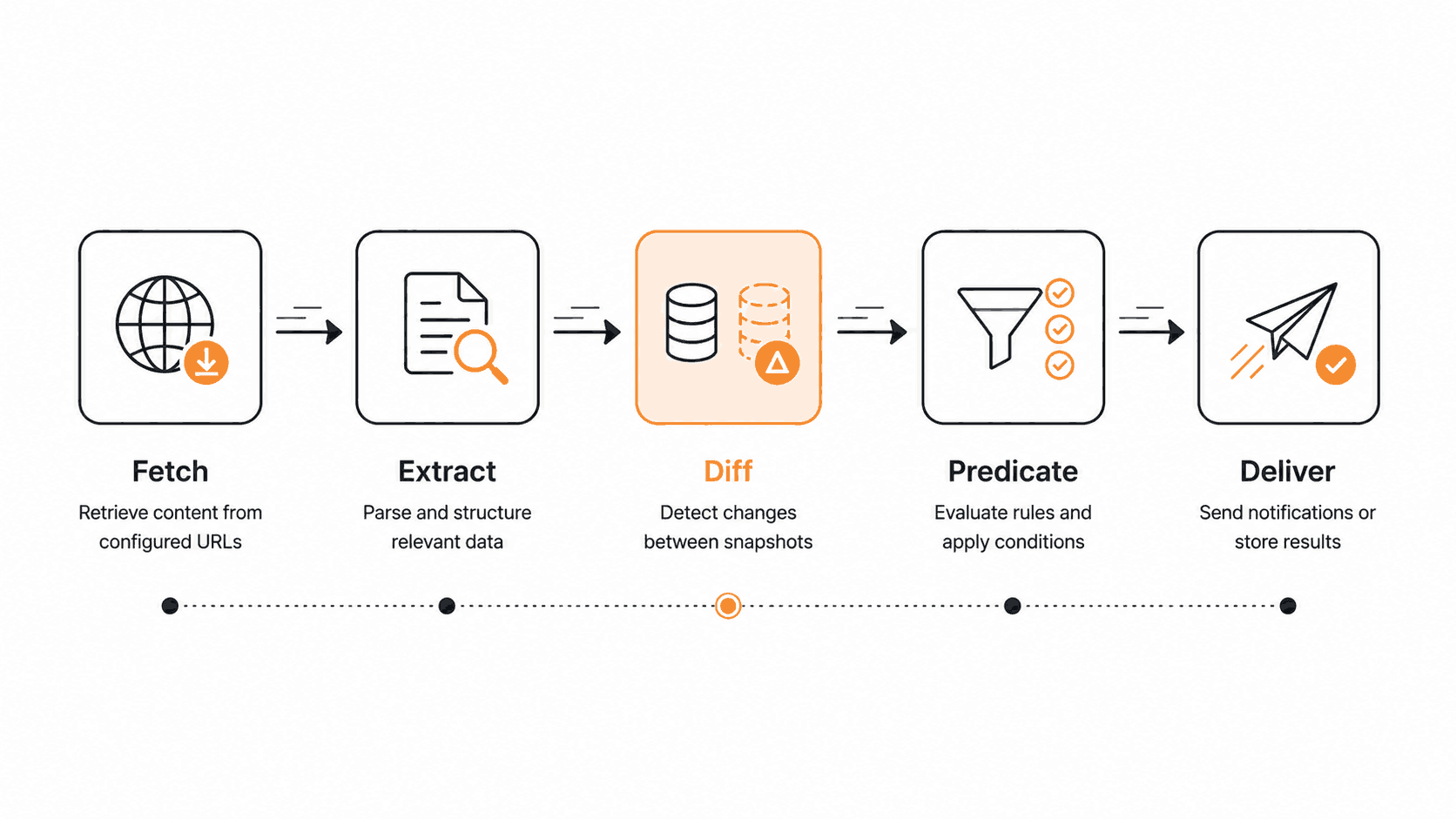
A reliable domain monitoring setup runs the same loop on every check:
| Stage | What Happens | Why It Matters |
|---|---|---|
| Fetch | HTTP request, headless browser fallback, proxy escalation | Handles static, JS-rendered, and bot-protected sites |
| Extract | CSS, XPath, JSONPath, regex, hash, or LLM prompt | Returns typed fields, not raw HTML |
| Diff | Field-level comparison vs. last successful run | Surfaces exactly what changed, before and after |
| Predicate | Evaluates your rule against the diff | Fires only when your condition is true |
| Deliver | Webhook, Slack, Discord, or email with retries | Reliable delivery with backoff and dead-letter queue |
How Verid Enables Domain Monitoring
Verid is a developer-first web change detection API designed to run the entire monitoring pipeline in a single API call. You define the URL, the extraction config, the predicate rule, and the delivery target. Verid handles scheduling, state storage, diff computation, retries, and signed webhook delivery.
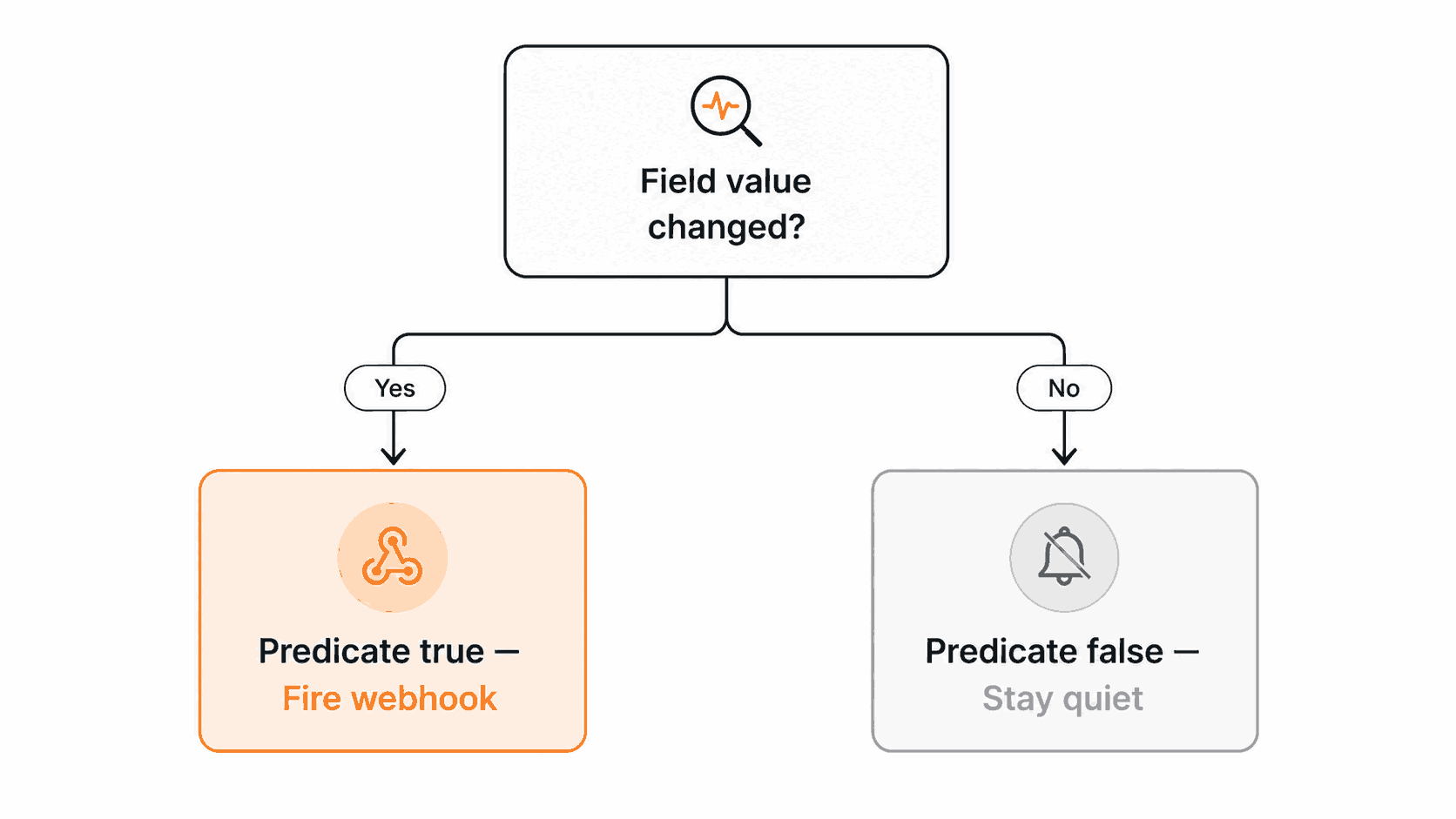
The key differentiator is the predicate layer. Rather than alerting on any byte-level change (the approach that makes screenshot tools noisy), Verid only fires a delivery when the rule you configured returns true. This keeps alert volume meaningful and actionable.
Extraction methods supported:
- CSS selectors
- XPath
- JSONPath
- Regular expressions
- Full-page hash
- LLM-powered natural language prompts (useful when selectors break)
Predicate types include: field changes, field equals, field matches regex, field increases/decreases by percent, and composites with AND/OR operators.
Delivery channels: HMAC-signed webhooks, Slack, Discord, and email all with six automatic retries and exponential backoff.
Learn more about Verid's extractor methods, change detection predicates, and notification delivery options.
Setting Up a Domain Monitor: Code Examples
1. Monitor a GitHub Release (JSONPath + field_changes)
curl -X POST https://api.verid.dev/v1/monitors \
  -H "Authorization: Bearer vrd_your_api_key" \
  -H "Content-Type: application/json" \
  -d '{
    "name": "React latest release",
    "url": "https://api.github.com/repos/facebook/react/releases/latest",
    "schedule_interval_seconds": 3600,
    "extract_config": {
      "method": "json_path",
      "fields": { "version": "$.tag_name" }
    },
    "diff_predicate": { "type": "field_changes", "field": "version" },
    "deliveries": [{ "type": "webhook", "url": "https://your-app.com/hooks/releases" }]
  }'
2. Monitor a Competitor Price (CSS + percent decrease)
curl -X POST https://api.verid.dev/v1/monitors \
  -H "Authorization: Bearer vrd_your_api_key" \
  -H "Content-Type: application/json" \
  -d '{
    "name": "Competitor pricing page",
    "url": "https://competitor.com/pricing",
    "schedule_interval_seconds": 1800,
    "extract_config": {
      "method": "css",
      "fields": { "price": ".pricing-card__amount" }
    },
    "diff_predicate": {
      "type": "field_decreases_by_percent",
      "field": "price",
      "threshold": 5
    },
    "deliveries": [{ "type": "slack", "url": "https://hooks.slack.com/services/YOUR/SLACK/WEBHOOK" }]
  }'
3. Composite Predicate: Price Drop on In-Stock Items Only
{
  "diff_predicate": {
    "type": "composite",
    "operator": "AND",
    "conditions": [
      {
        "type": "field_decreases_by_percent",
        "field": "price",
        "threshold": 10
      },
      {
        "type": "field_equals",
        "field": "availability",
        "value": "in_stock"
      }
    ]
  }
}
4. Verifying an Incoming Webhook (Node.js)
import crypto from "crypto";

function verifyVeridWebhook(rawBody, signature, secret) {
  const expected = crypto
    .createHmac("sha256", secret)
    .update(rawBody)
    .digest("hex");
  return crypto.timingSafeEqual(
    Buffer.from(expected),
    Buffer.from(signature)
  );
}

// In your Express route:
app.post("/hooks/releases", (req, res) => {
  const sig = req.headers["x-verid-signature"];
  if (!verifyVeridWebhook(req.rawBody, sig, process.env.VERID_SECRET)) {
    return res.status(401).send("Invalid signature");
  }
  const { monitor, fields } = req.body;
  console.log(`Monitor "${monitor.name}" fired:`, fields);
  res.sendStatus(200);
});
Start monitoring with a 14-day free trial at verid.dev. The trial includes unlimited monitors and 200 runs, with no credit card required. After it, plans start at $9 a month for 1,000 runs.
Verid vs. Alternatives
| Capability | DIY Scraper | Screenshot Tools | Verid |
|---|---|---|---|
| Structured field extraction | You write it | No (pixel diffs) | 6 methods built-in |
| Predicate-based alerting | You write it | No | 8 predicates + composites |
| Field-level diff history | You store it | Image diffs only | Per-field before/after |
| JS-heavy and bot-protected sites | You add headless + proxies | Limited | Auto-escalates |
| Signed webhook delivery | You write retries | Email/Slack only | HMAC + 6x backoff + DLQ |
| Time to first alert | Days | Minutes (then noise) | Minutes (and quiet) |
Frequently Asked Questions
What is domain monitoring?
Domain monitoring is the automated process of watching a URL, API endpoint, or web resource for specific changes and triggering alerts or workflows when those changes match defined conditions. It covers everything from tracking competitor prices and software releases to detecting compliance changes and API schema drift.
How is structured domain monitoring different from screenshot-based tools?
Screenshot tools detect any visual pixel change, which generates high alert noise from ads, timestamps, and cookie banners. Structured monitoring extracts named fields from a page or API response and only fires when your predicate rule returns true — for example, a price dropped 5% or a version field changed. The result is far fewer, far more actionable alerts.
Can I monitor JavaScript-rendered pages and bot-protected sites?
Yes. Verid handles this automatically with a three-layer fetching strategy: static HTTP fetch first, automatic fallback to a headless browser if extraction returns empty fields, and escalation to a residential proxy for bot-protected sites. No manual configuration is needed.
How do I avoid webhook alert noise on frequently updating pages?
Define a precise predicate. Instead of alerting on any change, configure a rule like field_decreases_by_percent with a threshold, or a composite predicate combining multiple conditions. Verid only delivers a webhook when the rule evaluates to true, ignoring all other byte-level changes on the page.
About the author

Software Engineer & Technical Writer
Software engineer and technical writer. Hanzala bridges Verid’s codebase and its documentation, writing the guides, reference pages and honest comparisons that get a developer from an idea to a working monitor.
More from HANZALA SALEEM →Related posts
Best Tools to Monitor Government Websites for Policy Changes in 2026
Compare free, no-code, developer, and enterprise tools for tracking government website and policy changes, plus how to build alerts that skip the noise.
Read the post →website monitoringWebsite Monitoring vs Uptime Monitoring: What's the Difference?
Uptime monitoring checks if a site is up. Website monitoring checks what it says. Learn the difference and when you need both.
Read the post →comparisonHexowatch Alternative for Developers: Best Website Monitoring Tools in 2026
Looking for a Hexowatch alternative with a real API? Compare the best developer-focused website monitoring and change detection tools in 2026.
Read the post →comparisonchangedetection.io vs Verid: Which Website Monitoring Tool Is Right for You?
changedetection.io vs Verid compared. See which website change detection tool fits your stack - screenshot alerts or structured API-driven monitoring.
Read the post →