Website Monitoring vs Uptime Monitoring: What's the Difference?
There is a question that comes up constantly in developer and DevOps circles, usually after someone has been burned: "We had uptime monitoring. Why didn't we know the pricing page broke?"
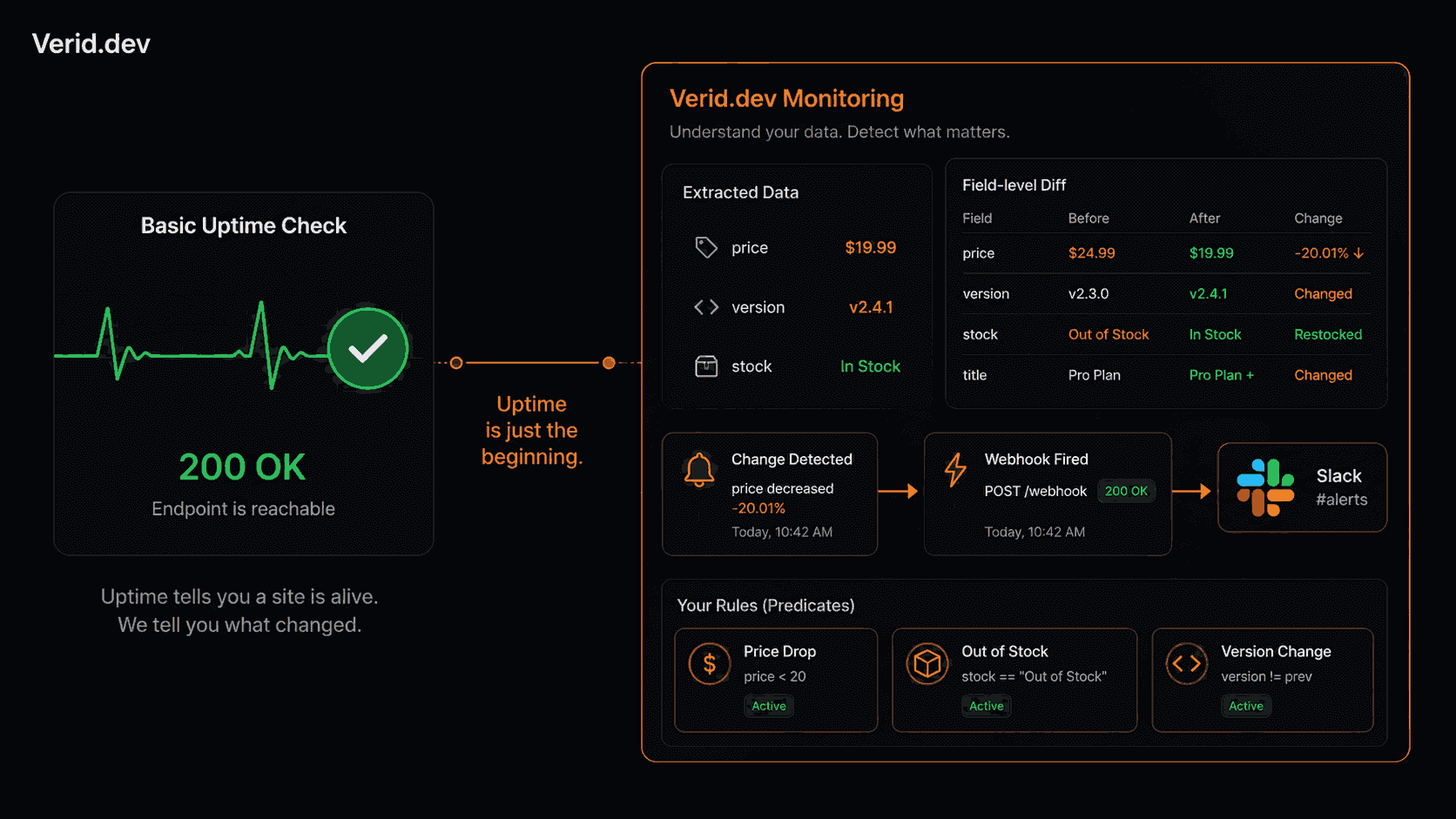
The short answer is that uptime monitoring and website monitoring answer completely different questions. Conflating the two is one of the most common blind spots in observability setups, and it costs teams real money.
This article explains both concepts clearly, covers when each is appropriate, and walks through the cases where you genuinely need both.
What is Uptime Monitoring?
Uptime monitoring checks whether a URL is reachable and returns an acceptable HTTP response. Most tools send an HTTP GET to your endpoint at regular intervals, check the response status code (usually 200 OK), and alert you if the check fails.
That's it. The server responded, or it didn't.
Common variants include:
- HTTP/HTTPS checks - did the endpoint return a 2xx?
- Ping/ICMP checks - is the host reachable at the network layer?
- Port checks - is a specific port open and accepting connections?
- SSL certificate checks - is the certificate valid and not expiring soon?
- Heartbeat/cron checks - did the expected periodic ping arrive?
Uptime monitoring is fast to set up, cheap to run, and gives you a genuinely useful signal: your service is either answering or it isn't. That binary is the first thing anyone needs to know during an incident.
What it doesn't know is anything about the content of the response. A page can return 200 OK while serving a blank white screen, a cached error message from three days ago, a checkout button pointing to a broken endpoint, or a pricing table with incorrect numbers. The uptime monitor sees "200" and reports everything is fine.
What is Website Monitoring?
Website monitoring is the broader practice of checking not just whether a page responds, but whether the content and structure of that response is correct and meaningful.
Depending on the tool, website monitoring can include:
- Keyword presence checks (does this page still contain the text "Free Trial"?)
- HTML and DOM structure validation
- Specific field extraction and comparison (is the price still $99?)
- Full-page hash comparison (did anything on this page change?)
- Form and flow testing (does the checkout still complete?)
- Structured data extraction with field-level diffs
- Content change detection with predicate-driven alerting
The critical distinction is that website monitoring cares about state, not just availability. It can tell you that a competitor dropped their price by 12%, that a critical API endpoint started returning a degraded status message, or that a legal policy page was quietly updated.
A useful mental model: uptime monitoring answers "is the server running?" and website monitoring answers "is the right content being served?"
Comparison Table
| Capability | Uptime Monitoring | Website Monitoring |
|---|---|---|
| Purpose | Availability detection | Content and state verification |
| Detects downtime | Yes | Yes (usually) |
| Detects content changes | No | Yes |
| Detects HTML structure changes | No | Yes |
| Detects pricing changes | No | Yes, with field extraction |
| Detects DOM updates | No | Yes |
| Detects text changes | No | Yes |
| Supports predicates / conditions | Rarely | Yes (advanced tools) |
| Structured field extraction | No | Yes (advanced tools) |
| API support | Varies | Yes (advanced tools) |
| Webhooks | Varies | Yes (advanced tools) |
| Developer automation | Limited | Yes |
| Business use cases | SLA tracking, incident detection | Competitive intelligence, content ops, compliance monitoring |
| Typical users | DevOps, SREs, ops teams | Developers, growth teams, SEO, product, compliance |
Key Differences
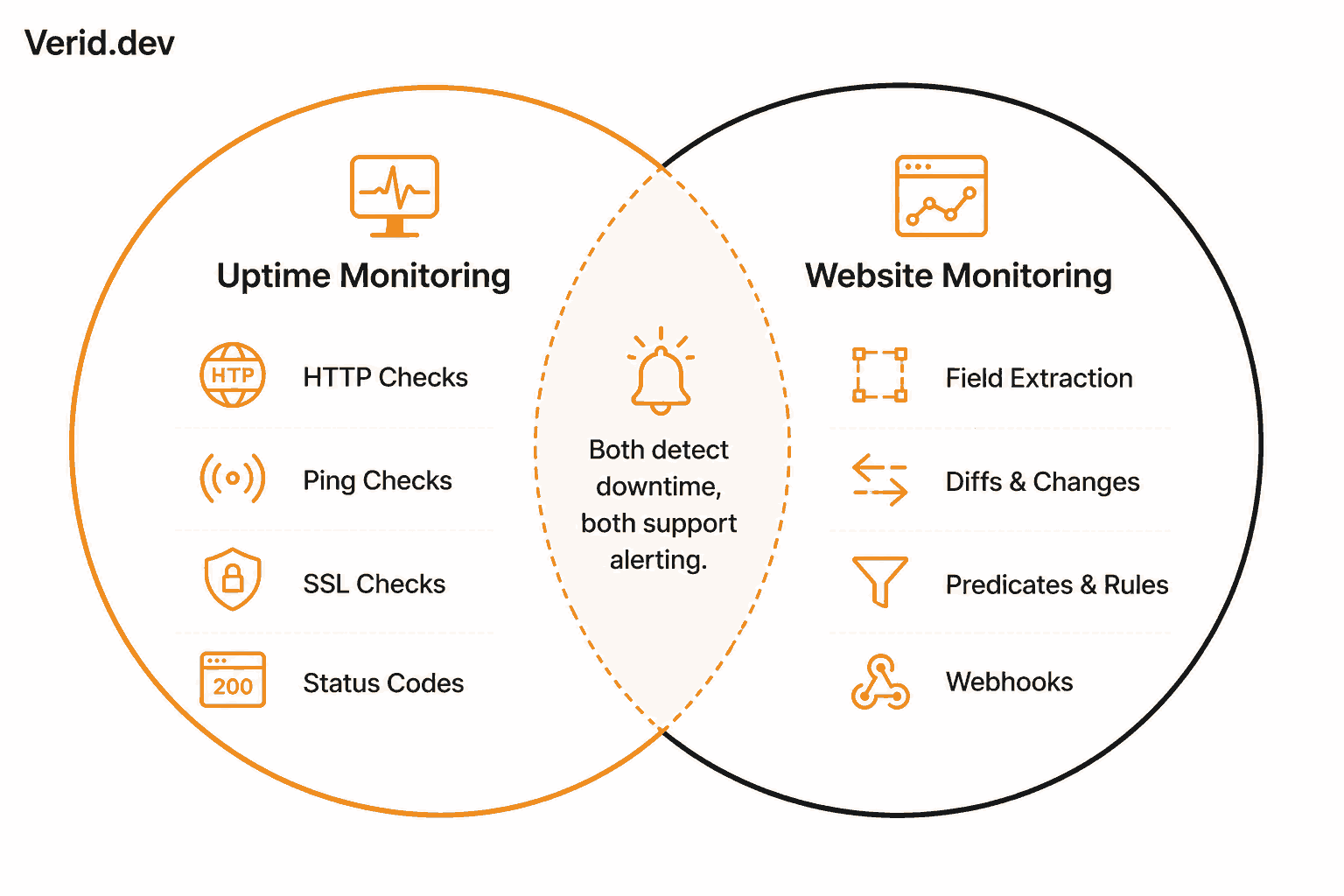
The practical difference shows up in these four situations.
A broken page that still returns 200. Uptime monitoring will pass it. Website monitoring, if configured with the right content checks, will catch it. This is the most common failure mode teams overlook.
Silent content drift. Prices change, legal terms update, product availability shifts. None of these events affect HTTP status codes. They are invisible to uptime monitors entirely.
Developer automation. If you want to trigger a workflow the moment a dependency releases a new version, a competitor crosses a price threshold, or a status page changes from "degraded" to "operational," uptime monitoring gives you nothing to work with. You need structured data, diffs, and programmable conditions.
Alert quality. Uptime monitoring is either on or off. Website monitoring with predicate-based alerting lets you say "only fire when the price field decreases by more than 10%" which is operationally much more useful than "something on this page changed."
Real-World Examples
To make this concrete, here are scenarios where the distinction actually matters.
E-commerce repricing. Your operations team wants to match competitor prices. An uptime monitor on their product pages tells you nothing. A website monitor that extracts the .product-price field and fires when it drops more than 5% is actionable data.
Dependency releases. An SRE is waiting on a security patch to land in an upstream npm package. An uptime check on npmjs.com confirms the registry is online. A website monitor watching registry.npmjs.org/package-name/latest with a JSONPath field extraction on $.version fires the moment the version string changes.
Status page monitoring. You want to know when a third-party vendor you depend on posts an incident. A website monitor watching their status page with a field_matches_regex predicate for terms like "degraded" or "outage" gives you that signal before your own users start reporting issues.
Legal and compliance. A legal team needs to know when a supplier's terms of service changes. No uptime monitor in the world will catch that. A full-page hash monitor will fire if a single character changes anywhere on the document.
SERP and SEO tracking. A growth team monitors whether a competitor's pricing page starts ranking for a target keyword. This is purely a content question, completely outside the scope of uptime monitoring.
When Uptime Monitoring Is Enough
There are real situations where basic uptime monitoring is the right and sufficient tool.
If you run an internal service and you just need to know whether the API is accepting connections, a simple HTTP check is adequate. If your goal is SLA reporting for a hosting provider, uptime percentage and response time are exactly the metrics you need. If you are monitoring a background job scheduler and just need confirmation the heartbeat fired, that's a heartbeat check, not a content monitor.
Uptime monitoring is also a reasonable starting point for teams with limited monitoring budgets. Getting any availability visibility is better than none. Start with uptime, then layer content checks as your needs grow.
When Website Monitoring Is Required
Website monitoring becomes necessary any time the content of a response matters, not just the existence of a response.
Use it when:
- You need to detect changes to specific fields on a page (price, stock, version, status)
- You are tracking competitor websites for intelligence purposes
- You monitor third-party documentation or policy pages for compliance
- You want to trigger automated workflows in response to content changes
- You are watching pages where false positives from noise (cookie banners, rotating ads, timestamps) would make screenshot-based tools unusable
- You need a structured before/after payload delivered to your own systems via webhook
When You Need Both
Most production teams end up needing both, serving different purposes in parallel.
Uptime monitoring handles the "is anything obviously broken?" layer. It is fast, simple, and catches gross failures immediately. Website monitoring handles the "is the right content in the right state?" layer. Together, they close most of the common observability gaps.
A typical setup might look like: an uptime monitor running every 60 seconds on your own services, and a website monitor running every 5 to 30 minutes on competitor pricing pages, upstream dependency registries, vendor status pages, and any internal pages where content correctness matters.
Why Structured Monitoring Beats Screenshot-Based Monitoring
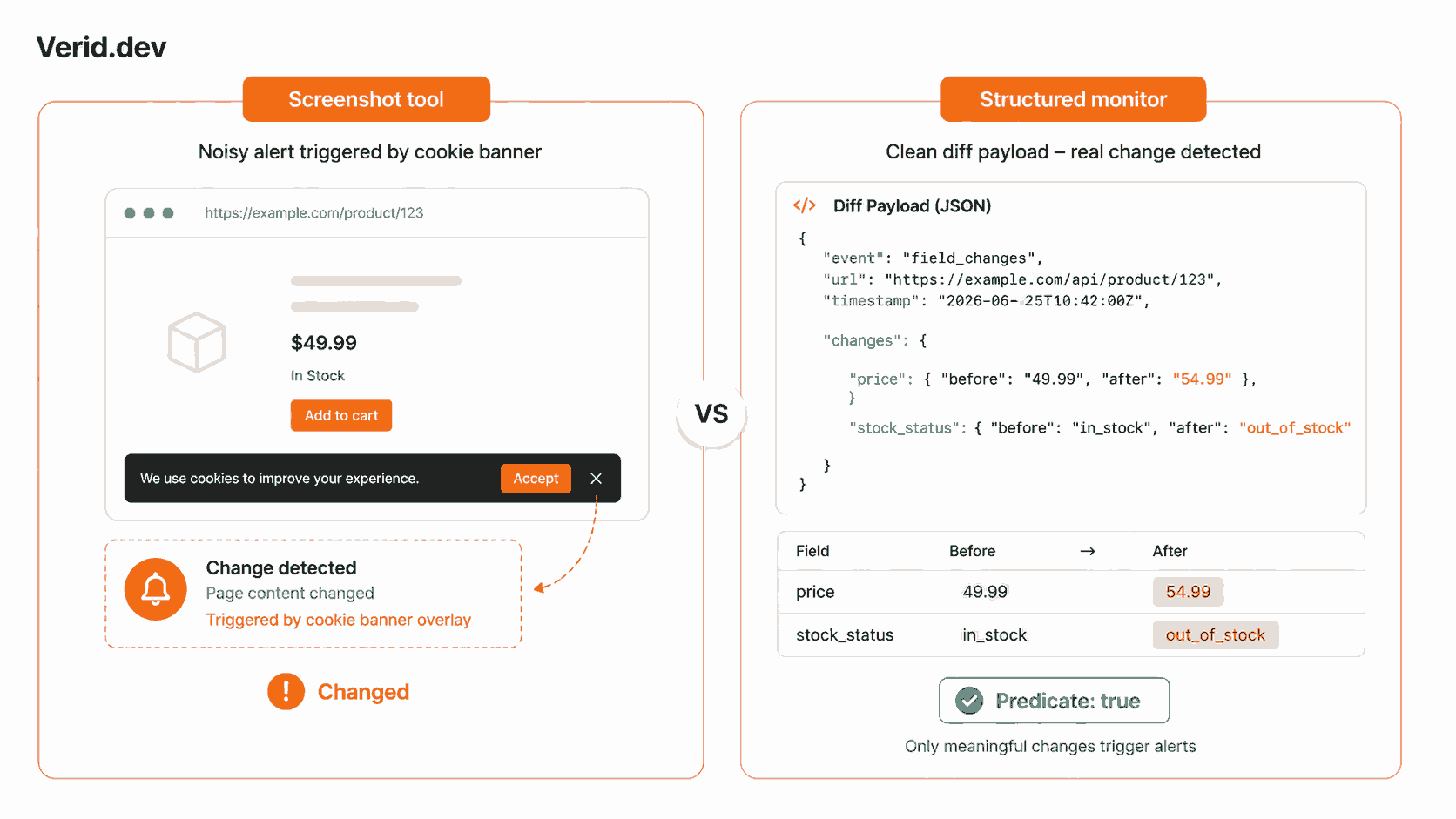
Screenshot and pixel-diff based tools solve a real problem, but they create a different one. They alert on everything. Cookie consent banners, A/B test variations, rotating promotional images, live chat widget updates, timestamps. All of these trigger "the page changed" alerts that have nothing to do with what you actually care about.
The signal-to-noise ratio on screenshot tools is terrible for any page with dynamic content, which is most pages on the modern web.
Structured extraction takes a different approach. Instead of capturing a pixel snapshot, it pulls specific named fields from the page: the price element, the stock status attribute, the version string from an API endpoint. Then it compares those fields against what was there last run. If nothing meaningful changed, nothing fires. If a field crosses the threshold you defined, you get a clean before/after payload delivered exactly where you want it.
This also makes the alerts programmable. The difference between "the page changed" and "fire only when this JSON field changes and only when the new value matches this regex pattern" is enormous in practice. The first is noise you eventually ignore. The second is a trigger you actually act on.
How Verid.dev Helps
Verid is built specifically for the structured website monitoring problem. It is a developer-first web change detection API that handles the full monitoring loop: fetch, extract, diff, evaluate a predicate, deliver.
The workflow is straightforward. You create a monitor via the REST API or the Node.js SDK, specifying the URL, a schedule interval, an extraction configuration, a predicate, and a delivery target.
Here is a minimal example using cURL to create a monitor that watches a competitor's pricing page and fires when the price drops by 10% or more:
curl -X POST https://api.verid.dev/v1/monitors \
  -H "Authorization: Bearer $VERID_API_KEY" \
  -H "Content-Type: application/json" \
  -d '{
    "name": "Competitor Pricing",
    "url": "https://competitor.com/pricing",
    "schedule_interval_seconds": 1800,
    "extract_config": {
      "method": "css",
      "fields": {
        "price": ".plan-price",
        "availability": "[data-stock]"
      }
    },
    "diff_predicate": {
      "type": "field_decreases_by_percent",
      "field": "price",
      "threshold": 10
    },
    "deliveries": [
      { "type": "webhook", "url": "https://your-app.com/hooks/pricing" }
    ]
  }'
When the predicate fires, Verid sends a signed webhook to your endpoint with a structured before/after diff:
{
  "monitor": "Competitor Pricing",
  "fired": "field_decreases_by_percent",
  "field": "price",
  "before": "99.00",
  "after":  "79.00",
  "at": "2026-06-25T09:31:00Z"
}
The same pattern works for tracking dependency releases via JSONPath on API endpoints, watching status pages with regex predicates, or monitoring any page where you want a specific field value, not a screenshot.
Verid supports six extraction methods: CSS selectors, XPath, JSONPath, regex, full-page hash, and AI/LLM extraction for pages where markup is unpredictable or heavily dynamic. Fetching escalates automatically from static HTTP through a headless browser to a residential proxy if a site resists the initial request, so you do not have to manage that infrastructure yourself.
For teams that want to combine conditions, composite predicates let you chain rules with AND/OR logic. For example, fire only when a price drops AND the item is marked in-stock:
{
  "type": "composite",
  "operator": "AND",
  "conditions": [
    { "type": "field_decreases_by_percent", "field": "price", "threshold": 5 },
    { "type": "field_equals", "field": "availability", "value": "in_stock" }
  ]
}
Delivery options include HMAC-signed webhooks, Slack, Discord, and email. Webhooks include 6 automatic retries with exponential backoff and a dead-letter queue so you never silently lose an alert. See the webhook documentation for signature verification examples in multiple languages.
If you want to go further, the predicates documentation covers all nine predicate types, and the extraction documentation covers every supported method with copy-paste examples.
Best Practices
A few things worth keeping in mind regardless of which tool you choose.
Start with uptime, then layer content checks. If you have zero monitoring, uptime is the fastest thing to add and catches the most obvious failures. Once that is stable, add content monitors for the pages where correctness matters.
Be specific about what you extract. The more specific your selector or field definition, the fewer false positives you will deal with. Targeting .plan-price is better than hashing the whole pricing page if what you care about is one field.
Tune your predicates to your use case. A field_changes predicate on a status page is appropriate. A field_decreases_by_percent predicate on a pricing page avoids noise from minor display formatting changes.
Verify webhook signatures. Any production implementation handling webhook deliveries should validate the signature before trusting the payload. Verid signs every webhook with HMAC-SHA256 using a per-monitor secret.
Separate your monitoring from your application stack. Running monitors from the same infrastructure you are monitoring defeats the purpose. External monitoring tools catch failures your own systems cannot see.
Conclusion
Uptime monitoring and website monitoring solve related but different problems. Uptime tells you if the lights are on. Website monitoring tells you if the right things are happening inside.
For infrastructure health, SLA tracking, and fast incident detection, uptime monitoring is the right tool. For competitive intelligence, compliance monitoring, content change detection, and developer automation, website monitoring with structured extraction is what you actually need. Most teams eventually want both.
The tooling has matured significantly. There is no longer a good reason to choose between screenshot noise and writing your own scrapers. Structured, predicate-driven monitoring with clean webhook delivery is table stakes for any team that takes observability seriously.
Frequently Asked Questions
What is the main difference between website monitoring and uptime monitoring?
Uptime monitoring checks whether a server responds to an HTTP request. Website monitoring checks whether the content of that response is correct. A page can return HTTP 200 while displaying broken content, stale data, or changed pricing. Uptime monitoring misses all of those cases; website monitoring catches them.
Can uptime monitoring detect content changes?
Basic uptime monitoring cannot detect content changes. Some uptime tools support keyword checks, which verify that a specific string is present in the response body, but this is a limited form of content monitoring. It cannot extract specific fields, compute diffs, or apply conditional logic to the changes it detects.
When should I use website monitoring instead of uptime monitoring?
Use website monitoring when you care about the content of a response, not just its status code. Common cases include monitoring competitor pricing pages, tracking documentation or legal policy changes, watching dependency registries for new releases, and triggering automated workflows in response to specific field value changes.
What is predicate-based monitoring?
Predicate-based monitoring fires alerts only when a rule you define evaluates to true against the extracted data. Instead of alerting on any change, you define conditions such as "the price field decreased by more than 10%" or "the status field matches the pattern 'degraded'". This dramatically reduces false positives compared to screenshot or full-page-hash tools and makes alerts significantly more actionable.
About the author

Software Engineer & Technical Writer
A software engineer and technical writer, Hanzala focuses on developer experience at Verid: SDKs, API reference, and step-by-step guides. He writes about change detection, scheduling, and alert design for teams automating web data.
More from HANZALA SALEEM →Related posts
Monitor AWS, Stripe, and GitHub Status Pages and Route Incidents to Slack Automatically
Stop checking status pages by hand. Route AWS, Stripe, and GitHub incidents straight to Slack with field-level monitors that only fire when it matters.
Read the post →website monitoringBest Tools to Monitor Government Websites for Policy Changes in 2026
Compare free, no-code, developer, and enterprise tools for tracking government website and policy changes, plus how to build alerts that skip the noise.
Read the post →comparisonHexowatch Alternative for Developers: Best Website Monitoring Tools in 2026
Looking for a Hexowatch alternative with a real API? Compare the best developer-focused website monitoring and change detection tools in 2026.
Read the post →comparisonchangedetection.io vs Verid: Which Website Monitoring Tool Is Right for You?
changedetection.io vs Verid compared. See which website change detection tool fits your stack - screenshot alerts or structured API-driven monitoring.
Read the post →