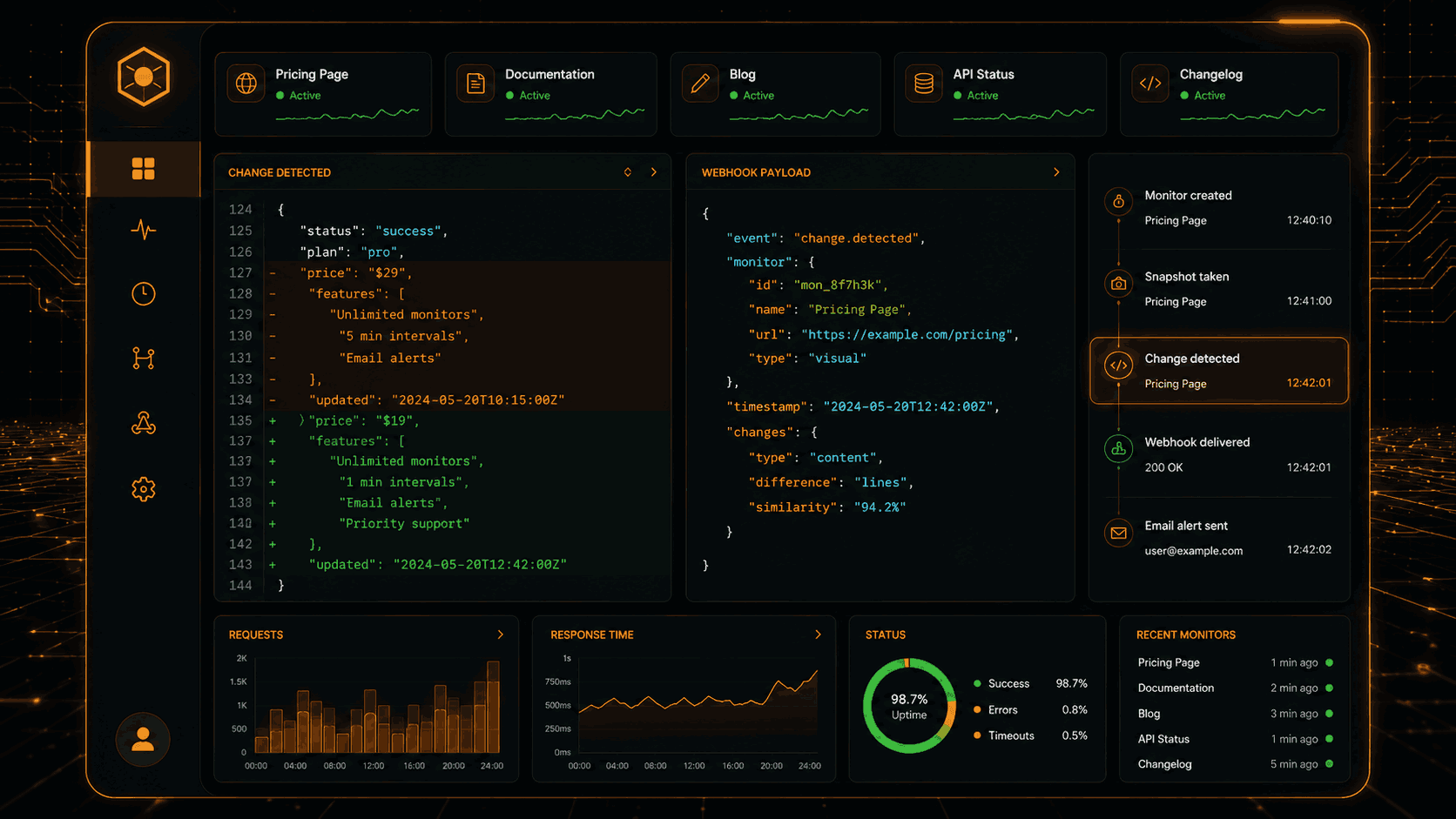
Hexowatch Alternative for Developers: Best Website Monitoring Tools in 2026
If you found Hexowatch through a Google search, tried to wire it into your pipeline, and then discovered it has no REST API, you are not alone. Most "website monitoring" tools are built for marketers who want screenshot diffs in an inbox. Developers need something different: structured field extraction, predicate-based alerting, and a webhook they can actually trust.
This post breaks down what Hexowatch does well, where it breaks for programmatic use cases, and which tools, including Verid.dev, give you the monitoring loop as an API.
Why Hexowatch Falls Short for Developers
Hexowatch is a solid no-code monitoring tool. It covers 13 monitor types and sends Slack or email alerts when a page changes. For a marketing team watching a competitor landing page, it works fine.
For developers, the problems are structural:
No public REST API. GetApp explicitly lists this under Hexowatch's FAQ: "No, Hexowatch does not have an API available." You cannot create monitors programmatically, query state, or integrate it into a CI/CD pipeline without going through Zapier as a middleman.
Screenshot-first alerting. The primary output is a visual diff of the page. That means you get paged when a cookie banner shifts pixels, an ad rotates, or a timestamp updates. The signal-to-noise ratio is poor for anything action-oriented.
No field-level state. Hexowatch tells you "the page changed." It does not tell you "the price field went from 49.99 to 39.99." You still have to write parsing logic on your end to act on the data.
No predicate control. You cannot say "only fire if price drops by more than 10%" or "only alert if the availability field matches In Stock." Every change fires an alert regardless of its business significance.
These are not bugs. They are design choices optimized for a non-developer audience. The tool does what it advertises. It just does not advertise what developers need.
Developer-Focused Alternatives Worth Knowing
Visualping
Visualping does screenshot diffs like Hexowatch but adds a CSS selector mode that narrows detection to a specific element. It has a basic API for enterprise plans. The alert output is still a rendered screenshot, not a typed value, so your consumer code has no structured diff to parse.
Distill.io
Distill runs as a browser extension or cloud agent and lets you target CSS selectors for change detection. It is closer to structured than Hexowatch, but it has no webhook signing, limited composable predicates, and the cloud agent pricing scales steeply at volume.
Apify / ScrapingBee
These are scraping infrastructure tools, not monitoring tools. They return HTML or JSON on demand. You still own the scheduling, state persistence, diffing logic, and alert routing. They solve the fetch problem but not the monitoring loop.
Custom DIY stack
The classic approach: write a cron job that fetches a URL, compares a value against a stored snapshot, and sends a Slack message. It works until it does not. Selectors break, the site adds bot protection, retries fail silently, and the diff logic grows. This is the path most teams regret six months in.
How Verid.dev Solves the Developer Layer
Verid is a developer-first change detection API. The core idea is simple: instead of diffing raw HTML or pixels, Verid extracts the specific fields you define, compares them against the previous run, and fires a delivery only when a predicate you wrote returns true.
The architecture runs five stages per monitor cycle: fetch, extract, diff, evaluate predicate, deliver. You configure the pipeline once. Verid runs the infrastructure.
Extraction Methods
Verid supports six extraction methods: CSS selectors, XPath, JSONPath, regex, full-page hash, and LLM-powered natural language extraction. Each method produces typed named fields, not raw markup.
For a JSON API endpoint, JSONPath is the right call:
"extract_config": {
  "method": "json_path",
  "fields": {
    "version": "$.tag_name",
    "published_at": "$.published_at"
  }
}
For an HTML page, a CSS selector or XPath expression targets the exact node. If a site updates its markup and your selector breaks, the LLM extractor is a config-level fallback: describe the field in plain English and it finds it without a code deploy.
Predicate-Based Alerting
This is the feature that separates Verid from every screenshot tool on the market. Smart predicates let you define the exact condition that makes a change worth acting on.
Nine predicate types are available. Composite predicates let you combine them with AND or OR logic:
{
  "type": "composite",
  "operator": "AND",
  "conditions": [
    {
      "type": "field_decreases_by_percent",
      "field": "price",
      "threshold": 10
    },
    {
      "type": "field_equals",
      "field": "availability",
      "value": "in_stock"
    }
  ]
}
That rule fires exactly once: when a price drops at least 10% on an item that is currently in stock. Nothing else triggers a delivery. Your Slack channel stays quiet until something meaningful happens.
Reliable Webhook Delivery
Every webhook delivery is HMAC-signed with your monitor's secret, retried up to six times with exponential backoff, and dead-lettered if all retries fail. You are not relying on a fire-and-forget POST.
The payload structure is clean and consistent:
{
  "monitor_id": "uuid",
  "fired_at": "2026-06-17T10:00:00Z",
  "diff": {
    "fields_changed": ["version"],
    "before": { "version": "v18.2.0" },
    "after":  { "version": "v19.0.0" }
  }
}
Signature verification in Node.js takes about ten lines using the standard crypto module. Full verification snippets in Python, Ruby, Go, and PHP are in the Verid webhooks docs.
Three-Layer Fetching
Static fetch runs first. If extraction returns empty fields, the job auto-escalates to a headless browser. Bot-protected sites fall through to a residential proxy network. You do not configure any of this. It happens automatically.
Comparison Table
| Capability | Hexowatch | Visualping / Distill | Verid |
|---|---|---|---|
| REST API (create monitors programmatically) | No | Limited / Enterprise only | Yes, OpenAPI 3.1 |
| Structured field extraction | No (screenshots) | Partial (CSS only) | Yes, 6 methods |
| Predicate-based alerting | No | No | Yes, 9 types + AND/OR |
| Field-level before/after diff | No | No | Yes, per field |
| HMAC-signed webhook | No | No | Yes, 6x retry + DLQ |
| JS/bot-protected sites | Limited | Limited | Auto-escalates (browser, proxy) |
| Node.js SDK | No | No | Yes (@verid.dev/sdk) |
| Free plan | Yes (limited) | Yes (limited) | 14-day free trial (unlimited monitors, 200 runs, no card) |
Practical Use Cases
Verid publishes use case patterns. The most common ones for developer teams:
Dependency release tracking. Watch GitHub releases, npm, or PyPI with JSONPath extraction. Get a webhook the moment a new version publishes so your update workflow triggers before your CI pipeline breaks. See the GitHub release tracker recipe.
Competitor price monitoring. Extract a price field from a product page every 15 minutes. Fire only when it drops by a threshold you define. Route the webhook to a repricing Lambda. No screenshots, no noise.
Inventory restock alerts. Target the availability field with a regex predicate (^In Stock$). Your fulfillment system gets a webhook the moment stock returns, not a screenshot of the product page.
API contract drift detection. Poll an upstream API on a short interval. Extract specific response fields with JSONPath. Fire when a field disappears or its value format changes. Catch breaking changes before they reach your users.
Regulatory filing monitoring. Government portals rarely provide RSS or webhooks. Use a full-page hash monitor on a filing index page to catch any content addition, then route to your legal team via Slack.
Implementation: Monitor an npm Package Release
Install the SDK:
npm install @verid.dev/sdkCreate the monitor and wire up a webhook handler:
import { VeridClient } from '@verid.dev/sdk';
import { createHmac, timingSafeEqual } from 'crypto';
import express from 'express';

const client = new VeridClient({ apiKey: process.env.VERID_API_KEY! });

// Create a monitor for the TypeScript npm release
const monitor = await client.monitors.create({
  name: 'TypeScript npm release',
  url: 'https://registry.npmjs.org/typescript/latest',
  schedule_interval_seconds: 1800,
  extract_config: {
    method: 'json_path',
    fields: { version: '$.version' },
  },
  diff_predicate: { type: 'field_changes', field: 'version' },
  deliveries: [
    { type: 'webhook', url: 'https://your-app.com/hooks/npm' },
    { type: 'slack',   url: process.env.SLACK_WEBHOOK_URL! },
  ],
});

console.log('Monitor created:', monitor.id);

// Verify incoming webhook signatures
const app = express();
app.use(express.raw({ type: 'application/json' }));

function verifySignature(header: string, rawBody: string, secret: string): boolean {
  const parts = Object.fromEntries(header.split(',').map(p => p.split('=')));
  const ts = parseInt(parts['t'] ?? '0', 10);
  const sig = parts['v1'];
  if (!ts || !sig) return false;
  if (Math.abs(Date.now() / 1000 - ts) > 300) return false;
  const expected = createHmac('sha256', secret).update(`${ts}.${rawBody}`).digest('hex');
  return timingSafeEqual(Buffer.from(expected, 'hex'), Buffer.from(sig, 'hex'));
}

app.post('/hooks/npm', (req, res) => {
  const header = req.headers['verid-signature'] as string;
  const rawBody = req.body.toString();

  if (!verifySignature(header, rawBody, process.env.WEBHOOK_SECRET!)) {
    return res.status(401).send('Invalid signature');
  }

  const payload = JSON.parse(rawBody);
  const { before, after } = payload.diff;
  console.log(`TypeScript updated: ${before.version} -> ${after.version}`);

  // Trigger your downstream workflow here
  res.sendStatus(200);
});

app.listen(3000);
This monitor checks the npm registry every 30 minutes, extracts the version field, and fires the webhook only when the version string changes. The Slack delivery runs in parallel at no extra configuration cost.
See verid.dev/pricing for plan limits. The 14-day free trial covers unlimited monitors and 200 runs (a monitor polled daily uses 14 of them), which is enough to evaluate the setup before committing.
FAQ
Does Hexowatch have a REST API for creating monitors programmatically?
No. As of 2026, Hexowatch does not expose a public REST API for monitor creation or management. Integrations go through Zapier or their internal webhook output. If you need programmatic control over your monitoring pipeline, you need a different tool.
What is the difference between change detection and uptime monitoring?
Uptime monitoring (UptimeRobot, Freshping, etc.) checks whether a URL returns a 2xx status code. Change detection checks whether the content at that URL has changed in a way you care about. Most developer pipelines need both: uptime for infrastructure alerts and change detection for data-driven automation.
Can Verid monitor JavaScript-rendered pages?
Yes. Verid starts with a static HTTP fetch. If extraction returns empty fields, the job retries automatically with a headless browser. Bot-protected sites fall through to a residential proxy network. You set the extraction config once; the fetch escalation is handled internally.
How do I prevent webhook spam on dynamic pages that change constantly?
Use a predicate. Verid only fires a delivery when the rule you define returns true. For a price field, set field_decreases_by_percent with a threshold. For a version field, use field_changes. For volatile pages where you want any change, combine field_changes with a field_equals condition on a status field. The change detection docs cover all nine predicate types with copy-paste examples.
About the author

Software Engineer & Technical Writer
A software engineer and technical writer, Hanzala focuses on developer experience at Verid: SDKs, API reference, and step-by-step guides. He writes about change detection, scheduling, and alert design for teams automating web data.
More from HANZALA SALEEM →Related posts
changedetection.io vs Verid: Which Website Monitoring Tool Is Right for You?
changedetection.io vs Verid compared. See which website change detection tool fits your stack - screenshot alerts or structured API-driven monitoring.
Read the post →change detectionFree Website Change Monitors Compared (No Card Required)
Compare free website change monitors that need no credit card. Real limits, check frequency, and which tool actually fits your use case.
Read the post →comparisonApify Alternative for Scheduled Website Monitoring
Compare Apify Actors to a dedicated change monitoring API. See when building an Actor makes sense, and when webhooks on a rule get you there faster.
Read the post →comparisonFirecrawl vs Verid: A Scraping API and a Monitoring Loop Are Not the Same Thing
Firecrawl scrapes and now checks pages on a schedule. Verid is built only for monitoring. Here's the real architectural difference.
Read the post →