Firecrawl vs Verid: A Scraping API and a Monitoring Loop Are Not the Same Thing
If you've searched for "Firecrawl alternative" or "website monitoring API" recently, you've probably landed on pages that treat scraping and monitoring as interchangeable. They aren't, and the difference matters the moment you try to build something that runs unattended for months.
Firecrawl is built to answer the question "what's on this page right now, in a format my model can use." It scrapes, crawls, searches, and (as of its newer /monitor endpoint) checks pages on a schedule too. Verid was built to answer a narrower question from day one: "did the thing I care about on this page just change, and should I hear about it." That difference in starting point shapes almost everything else about how each tool behaves in production.
This isn't a "Firecrawl is bad" post. Firecrawl is serious infrastructure with real reach across scraping, crawling, and search, and it has moved into monitoring territory too. The goal here is to explain what each tool is optimized for, so you stop paying for scraping credits to run a job that's really a monitoring problem, or vice versa.
What Is Firecrawl?
Firecrawl positions itself as the context API to search, scrape, and interact with the web at scale, turning any source into clean markdown or structured data for AI agents and applications. Its core surface is four capabilities: search, scrape, crawl, and interact.
/scrape takes a URL and returns clean markdown, HTML, a screenshot, or structured JSON pulled against a schema, and it handles JavaScript rendering and dynamic content automatically. /crawl follows links from a starting URL across a site, respecting depth limits and path filters. /search runs a web query and returns full page content for each result in one call, and /interact handles pages that need clicking, typing, or navigating before the data you want is reachable.
Firecrawl is open source, ships SDKs for six languages, and has an official MCP server so agents in tools like Claude and Cursor can call it directly. It's aimed at teams feeding live web data into LLM applications: RAG pipelines, deep research agents, lead enrichment, and onboarding flows that need to read a URL and turn it into usable context in one shot.
What Is Verid?
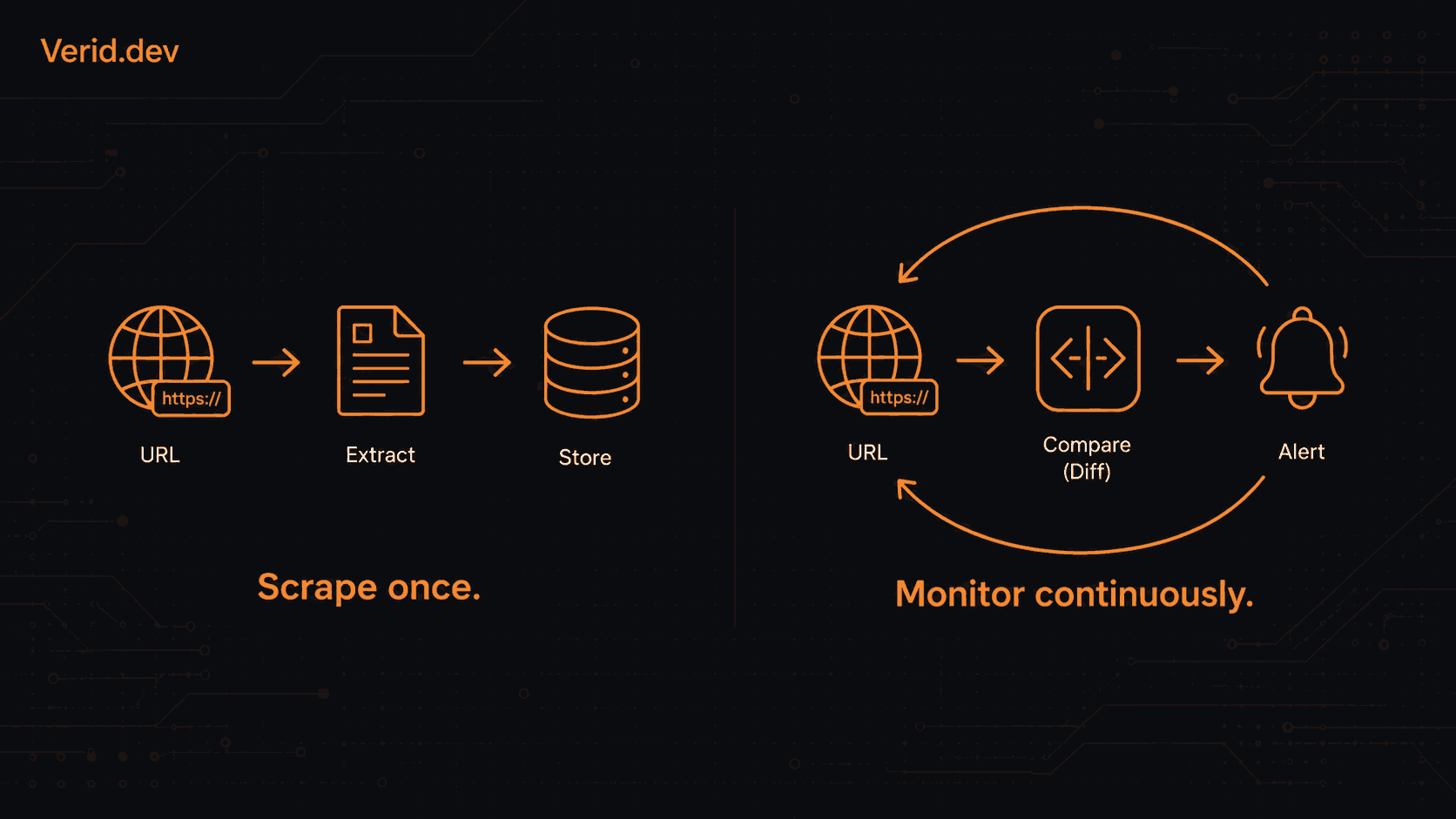
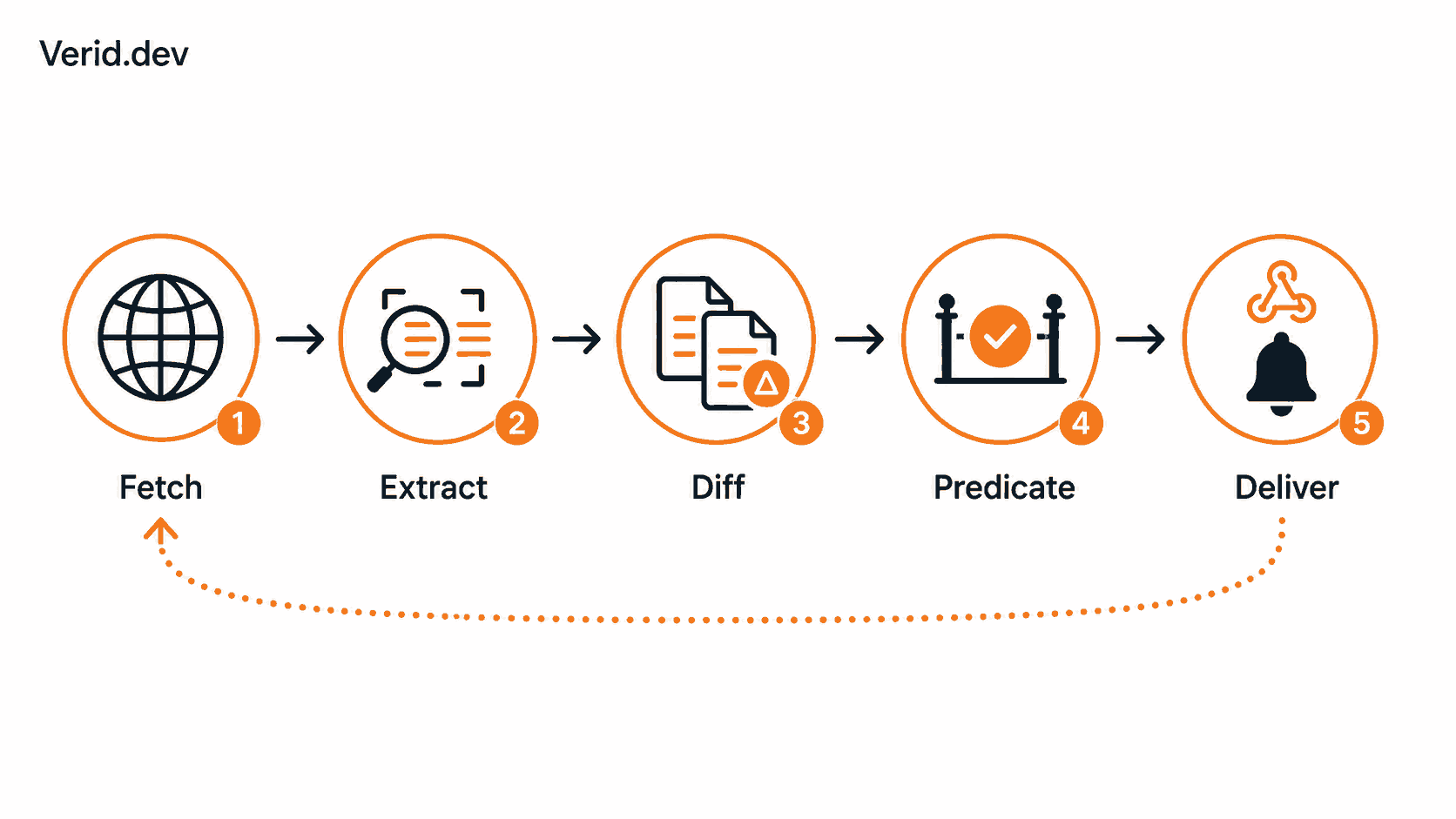
Verid describes itself as a programmatic Google Alerts alternative: you monitor any URL, extract the exact field you care about with CSS, XPath, JSONPath, or AI, and get a webhook when the rule you define fires. There is no crawl endpoint, no search endpoint, no "return me the whole page as markdown" mode as the primary product. Every monitor runs the same five-stage loop: fetch, extract, diff, evaluate a predicate, and deliver.
On the fetch side, Verid tries a static fetch first and automatically escalates to a headless browser and then a residential proxy if the site resists. For extraction, you pick from six methods: CSS selectors, XPath, JSONPath, regex, a full-page hash, or an AI prompt for pages where selectors keep breaking. Every run's output is compared field by field against the last successful run, and a predicate you define (one of nine types, including percentage thresholds, equality checks, regex matches, and AND/OR composites) decides whether anything actually gets sent. When it does, delivery goes out as an HMAC-signed webhook, Slack message, Discord post, or email, with six retries and a dead-letter queue for anything that still fails.
The product only exists to answer "did this specific value change in a way I defined in advance," repeatedly, without you writing the scheduler, the diff logic, or the alert rules yourself.
What Is the Difference Between Scraping and Monitoring?
Scraping retrieves the current state of a page. Monitoring repeatedly checks a page, keeps track of its previous state, and decides whether the difference between old and new is worth telling anyone about. A scrape is a single request-response exchange. Monitoring is a standing process with memory: it has to store what it saw last time, compare it to what it sees now, and apply a rule before anything happens downstream.
That last part, the rule, is where a lot of "monitoring" tools quietly fall short. Diffing two versions of a page is a solved problem. Deciding which diffs are worth an alert is not, and it's usually the part teams end up building by hand: ignoring rotating ad banners, ignoring a copyright year ticking over, catching a genuine 10% price drop without catching every 2% currency-display flicker.
What Happens When You Turn Scraping Into Monitoring?
To get from a scraping API to a working monitoring system, you generally need to add five things on top: a scheduler, persistent storage for the last known state, a diffing step, a rule engine that decides what counts as a meaningful change, and a delivery mechanism with retries. None of that is exotic engineering, but it's the part that breaks quietly at 2 a.m. when a selector shifts or a retry queue fills up unattended.
Firecrawl's own /monitor endpoint exists because enough users were building that layer themselves on top of /scrape. It runs scheduled checks on a page, a batch of URLs, or an entire crawled site, diffs each run against the last, and uses what Firecrawl calls an AI judge: a model that scores each diff against a goal you write in plain English, like "alert me when pricing changes," so timestamp changes and rotating testimonials don't fire a notification. Results land as a webhook, email, or Slack message. It's a legitimate answer to the same problem Verid solves, built from the scraping side rather than starting from monitoring as the whole product.
The distinction that survives this is architectural, not "one tool can monitor and one can't." Firecrawl's judgment layer is a language model scoring a diff against a natural-language goal, which is flexible and easy to set up, but probabilistic; the same diff can, in principle, be judged differently on different runs depending on how the model reads your goal. Verid's predicates are deterministic and typed: "price decreases by more than 10%" either evaluates true or it doesn't, on a named field, every time, and you can inspect exactly why an alert fired. If you want plain-English flexibility across an entire site with minimal setup, that trade favors an AI judge. If you want a rule you can unit test and reason about at 3 a.m. when it wakes you up, that trade favors typed predicates.
Firecrawl vs Verid: Comparison Table
| Capability | Firecrawl | Verid |
|---|---|---|
| Primary product surface | Search, scrape, crawl, interact, plus /monitor | Monitoring only |
| Extraction methods | Markdown, HTML, screenshots, JSON via schema | CSS, XPath, JSONPath, regex, full-page hash, AI prompt |
| Change judgment | AI judge scores a diff against a plain-English goal | 9 deterministic predicate types on named fields, incl. AND/OR composites |
| Scheduling | Custom cron or plain-English interval on /monitor | Interval set per monitor, as often as every minute on every plan |
| Fetch escalation | Automatic JS rendering | Static fetch, escalates to headless browser, then residential proxy |
| Delivery | Webhook, email, Slack (dashboard-configured) | HMAC-signed webhook, Slack, Discord, email, with 6 retries and a dead-letter queue |
| Whole-site or search-wide watching | Yes, crawl-based site monitors and goal-matched search monitors | No, monitors are per-URL or per-endpoint |
| SDK / API | REST API, OpenAPI spec, SDKs for 6 languages, MCP server | REST API, OpenAPI 3.1 spec, official Node.js SDK |
| Free tier | 1,000 scrape credits per month | 14-day free trial, no card (unlimited monitors, 200 runs) |
When Should You Use Firecrawl?
Reach for Firecrawl when the job starts with "I need the content of this page (or these hundred pages) right now, in a clean format." Feeding a RAG pipeline, pulling structured product data during a one-time import, letting an agent browse and act on a page mid-conversation, or crawling a documentation site to build a knowledge base are all scraping problems first. If you also want an occasional check for changes on some of those same pages, /monitor covers that without leaving the platform, especially if a plain-English goal is enough precision for your alerting.
When Does Verid Make More Sense?
Reach for Verid when the job is "watch this value forever and tell me the moment a specific condition is true." Competitor price tracking gated on a percentage drop, restock alerts scoped to one CSS-selected availability string, GitHub or npm release tracking on a semver field, WHOIS or domain expiry monitoring, or SERP position tracking are monitoring problems where you already know the exact field and the exact rule before you write any code. If you need an audit trail of every before/after value and a rule that behaves identically every time it runs, that's Verid's predicate-based alerting model, not a scored judgment call.
How Does a Monitoring Loop Work Technically?
Monitoring loop

URL
 ↓
Fetch (static, then browser, then proxy if needed)
 ↓
Extract typed fields (CSS / XPath / JSONPath / regex / hash / AI)
 ↓
Diff against last successful run
 ↓
Evaluate predicate (did the rule you defined return true?)
 ↓
Deliver (signed webhook, Slack, Discord, email) if true, stay quiet if false
 ↓
Wait for the scheduled interval
 ↓
Repeat
Every Verid monitor executes this loop on the schedule you set. The change detection documentation covers the full predicate reference, and the webhook notifications guide covers signature verification.
Practical Use Cases
- Competitor pricing: extract a price field with CSS or XPath and fire only when it drops past a threshold, using competitor price tracking.
- Dependency and release monitoring: watch a GitHub, npm, or PyPI JSON endpoint with JSONPath and alert on a version field change before it breaks CI. See dependency release monitoring.
- Regulatory and policy pages: full-page hashing catches any edit to a government portal or policy page without writing a selector, covered in regulatory filings and policy pages.
- Restock alerts: extract an availability string and fire only when it equals "in stock," detailed in restock alerts.
- API contract drift: poll an upstream JSON API on a short interval and catch a schema or field change before it hits production, via JSON API field monitoring.
Code Example: Creating a Verid Monitor
This example follows the exact request shape documented in Verid's quickstart guide: a JSONPath extractor pulling a version field from the GitHub releases API, with a field_changes predicate and a signed webhook delivery.
curl -X POST https://api.verid.dev/v1/monitors \
  -H "Authorization: Bearer $VERID_API_KEY" \
  -H "Content-Type: application/json" \
  -d '{
    "name": "React New Releases",
    "url": "https://api.github.com/repos/facebook/react/releases/latest",
    "schedule_interval_seconds": 3600,
    "extract_config": {
      "method": "json_path",
      "fields": {
        "tag_name": "$.tag_name",
        "name": "$.name",
        "published_at": "$.published_at"
      }
    },
    "diff_predicate": {
      "type": "field_changes",
      "field": "tag_name"
    },
    "deliveries": [
      {
        "type": "webhook",
        "url": "https://your-app.com/webhooks/verid"
      }
    ]
  }'
When the tracked field changes, the webhook payload carries the exact before and after values, not the whole page:
{
  "id": "del_01H...",
  "monitor_id": "uuid",
  "run_id": "uuid",
  "fired_at": "2026-05-08T12:00:00Z",
  "diff": {
    "fields_changed": ["tag_name"],
    "before": { "tag_name": "v18.2.0" },
    "after": { "tag_name": "v18.3.0" }
  }
}
Every webhook carries a signature header, and Verid's docs provide verification snippets in Node.js, Python, Ruby, Go, and PHP so you can confirm a payload actually came from Verid before acting on it.
Which Approach Should Developers Choose?
If your task is "get clean data out of a page or a site right now, or feed an agent live web context," start with Firecrawl. If you also want occasional change checks on those same URLs and a natural-language goal is precise enough for your use case, /monitor handles that without adding a second vendor.
If your task is "watch a specific field forever and only tell me when a rule I can name is true," start with Verid. The narrower scope means less setup for that one job: no schema to define for a scrape you're not otherwise running, no goal-writing for an AI judge, just a URL, an extractor, and a predicate.
Some teams run both: Firecrawl for ad hoc scraping and agent-facing data pulls, Verid for the smaller set of production alerts where a false positive or a missed change has a real cost. That split isn't wasteful; the two products are optimized for different failure modes, which shows up in how each is priced, from Firecrawl's per-page credit model to Verid's run-based pricing that scales with how many checks you run, with unlimited monitors on every plan.
Conclusion
Firecrawl and Verid overlap more than they used to now that Firecrawl ships its own scheduled monitoring, but the products still start from different premises. Firecrawl starts from "get me clean web data" and extended that into checking pages on a schedule with a language model judging what matters. Verid starts from "tell me when a specific, predefined condition becomes true" and never tries to be a general scraping platform. Picking between them is really a question of whether you want the flexibility of a broad platform with monitoring as one feature, or a tool where every design decision, from the extractor list to the predicate types to the retry queue, exists only to make unattended alerting reliable.
Frequently Asked Questions
Can a scraping API monitor websites for changes?
Yes, with either extra engineering on your side (scheduler, storage, diff logic, alert rules) or by using a scraping platform's own monitoring feature, such as Firecrawl's /monitor endpoint. What you get depends on how that feature judges a change: an AI judge scoring a diff against a goal behaves differently than a deterministic predicate evaluated against a named field.
Do I need Firecrawl if I only need change detection?
Not necessarily. If your entire use case is watching a handful of fields for defined conditions, a dedicated monitoring API like Verid gets you there with less setup, since the scheduler, diffing, predicates, and signed delivery are the whole product rather than a feature layered on scraping infrastructure.
What is the difference between crawling and monitoring?
Crawling discovers and retrieves pages across a site, typically once per run, by following links from a starting URL. Monitoring repeatedly checks the same page or field over time and reacts only when something changes according to a rule you define. Firecrawl's /crawl does the former; Verid's monitor loop and Firecrawl's /monitor both do the latter.
How do I stop a monitoring tool from alerting on every minor change?
Gate delivery on a rule instead of alerting on any detected diff. Verid does this with typed predicates like percentage thresholds and field equality checks; Firecrawl's /monitor does it with an AI judge scoring each diff against a plain-English goal. Both approaches exist specifically to solve the noise problem that whole-page screenshot diff tools tend to have.
About the author

Software Engineer & Technical Writer
A software engineer and technical writer, Hanzala focuses on developer experience at Verid: SDKs, API reference, and step-by-step guides. He writes about change detection, scheduling, and alert design for teams automating web data.
More from HANZALA SALEEM →Related posts
Free Website Change Monitors Compared (No Card Required)
Compare free website change monitors that need no credit card. Real limits, check frequency, and which tool actually fits your use case.
Read the post →comparisonApify Alternative for Scheduled Website Monitoring
Compare Apify Actors to a dedicated change monitoring API. See when building an Actor makes sense, and when webhooks on a rule get you there faster.
Read the post →comparisonWachete Alternative for Developers: Get Structured Data, Not Raw Diffs
Wachete shows you raw diffs. Verid extracts the exact field you care about and fires a webhook only when your predicate is true. No noise, no glue code.
Read the post →comparisonDistill Alternatives for Teams That Need an API Instead of a Browser Extension
Distill works fine as a browser extension. But when your team needs an API, predicates, webhooks, and zero glue code, here's what to use instead.
Read the post →