Distill Alternatives for Teams That Need an API Instead of a Browser Extension
Distill is genuinely good at what it does. As a browser extension that watches a DOM element and emails you when it changes, it solves a real problem without requiring any backend code. For individual users, it's hard to argue with.
The problem shows up when a second person joins the project.
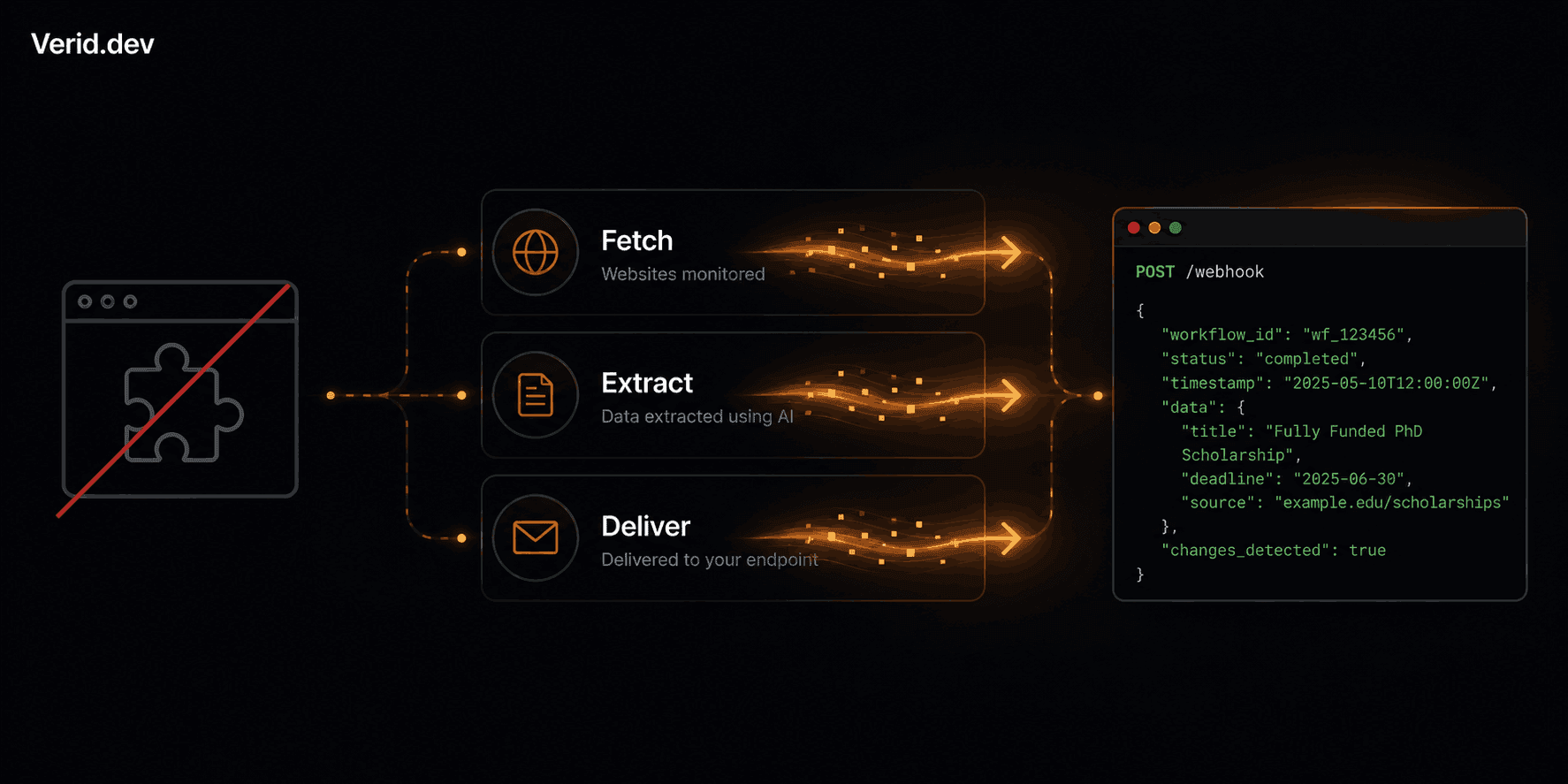
You can't share a browser extension session. You can't version control a monitor config that lives inside a Chrome profile. You can't trigger a repricer, open a ticket, or update a database row when Distill fires an alert, at least not without building a fragile Zapier chain around it. And you definitely can't spin up 200 monitors from a deployment script.
This post is for the team that has already made peace with those limitations and is now looking for something different: specifically, a tool built around an HTTP API, not a browser plugin.
What Distill Actually Is
Distill is a website change monitoring tool that runs primarily as a browser extension, with an optional cloud monitoring mode on paid plans. You point it at a page, optionally highlight a section using CSS or XPath selectors, set a check frequency, and receive an alert when the content shifts.
It's a solid product for researchers, solo developers watching a handful of pages, and anyone who wants to track changes without writing code. The local monitoring mode is actually useful in cases where you're checking pages behind a login that isn't easily scriptable.
What it is not is an API-first monitoring infrastructure. There's no REST API for creating monitors programmatically, no webhook delivery with retry logic, and no predicates – any change, including a rotating ad or a cookie banner timestamp, triggers an alert. For teams building automated pipelines, that's the gap.
Why Teams Outgrow Browser Extensions
The browser extension model makes one significant architectural assumption: a human is watching the results. Alerts go to email or push notifications, and a person decides what to do next.
That assumption breaks in three common situations.
Automation. If the goal is to restock a product, update a pricing table, or open a Jira ticket when a competitor page changes, an email is not the right delivery mechanism. You need a webhook your application can consume directly.
Scale. Browser extensions don't scale horizontally. A developer team monitoring 50 competitor pricing pages, 30 dependency release feeds, and 20 regulatory portals needs infrastructure that runs on a schedule whether or not anyone's browser is open.
Collaboration. Monitor configs inside a Chrome extension aren't reviewable, diffable, or deployable. When two engineers manage the same monitors – or when you want them defined in the same repo as the application consuming their webhooks – you need a config format that fits existing tooling.
What Makes a Good Distill Alternative for Developers
Not every Distill alternative targets the same use case. A few things separate developer-grade monitoring tools from general-purpose page watchers:
Programmatic monitor creation. A proper REST API for creating, updating, and deleting monitors from code is non-negotiable for teams. This rules out tools that are purely GUI-driven.
Predicate-based alerting. "The page changed" is noise. Useful alerting means you can define conditions: fire only when the price drops more than 10%, fire only when the version field actually changes, fire only when availability transitions to "in_stock". Without predicates, you're building a filter layer yourself.
Structured extraction. You want the changed value, not a raw HTML diff or a screenshot. CSS selectors, XPath, JSONPath for API endpoints, and ideally an LLM-based fallback for pages where markup keeps moving.
Signed webhook delivery with retry logic. If your webhook endpoint is temporarily unavailable, the alert should not be silently dropped. Retry with backoff and a dead-letter mechanism is standard practice in modern event-driven systems -- see how webhooks are handled in the HTTP specification context and how HMAC signature verification protects against replay attacks.
Bot and JS handling. A monitoring tool that only works on static HTML covers maybe half the web. JavaScript-rendered pages, SPAs, and bot-protected sites are common. Automatic escalation to a headless browser without manual configuration is a meaningful quality-of-life feature.
Why Verid Is Built for Developers
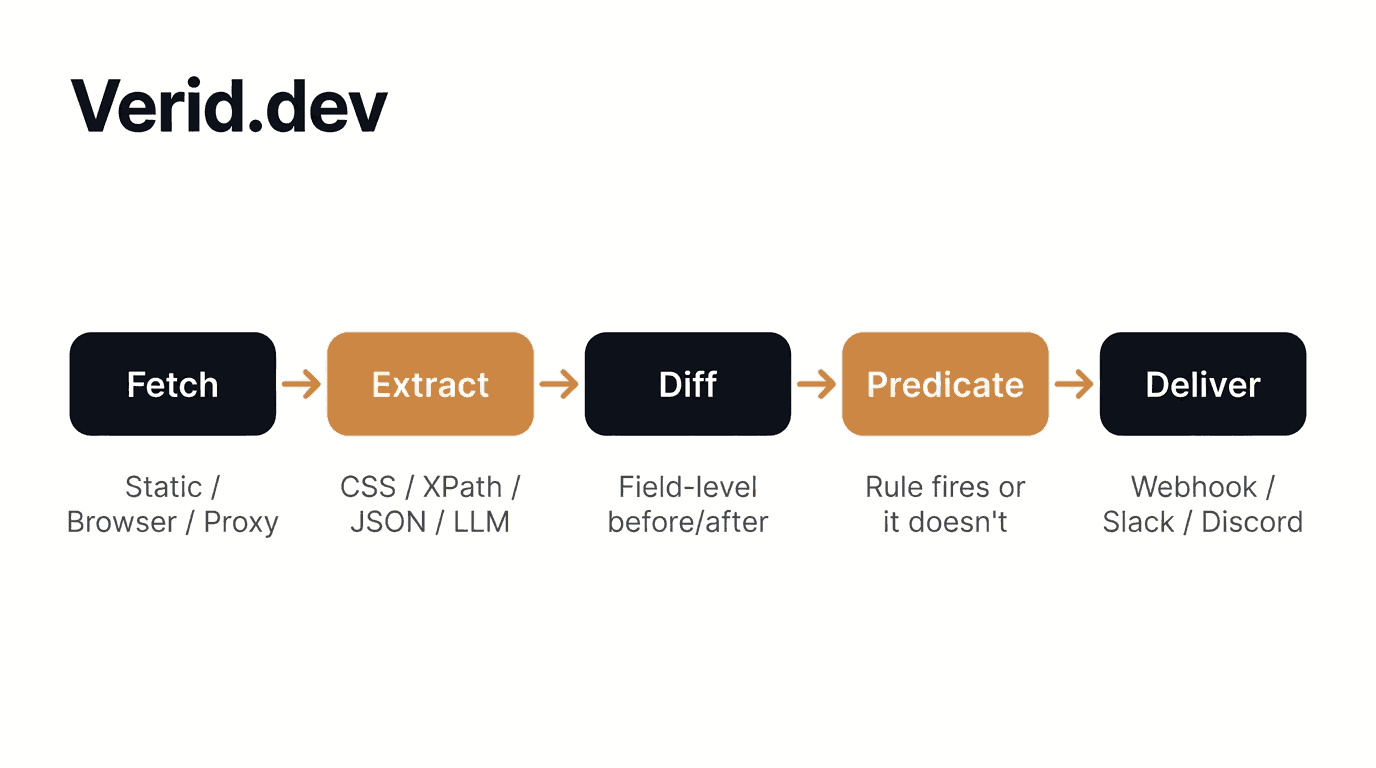
Verid is a web change detection API built specifically around the pipeline model: fetch, extract, diff, evaluate a predicate, deliver. Every monitor runs this loop on a schedule you set. You configure it once via API; Verid handles the infrastructure.
The architecture directly addresses the gaps that browser extensions leave open.
Six extraction methods. CSS selectors, XPath, JSONPath, regex, full-page hashing, and LLM-based extraction cover the full range from structured HTML pages to REST API responses to dynamic pages where markup shifts frequently. The LLM extractor takes a plain-English field description -- "the current sale price in USD" -- so you're not locked out when a site redesign breaks your selectors.
Nine predicate types. Verid's change detection engine supports field-level conditions including percentage-based thresholds (price dropped 5%), absolute thresholds, regex matches, field equality, and composite AND/OR logic. You're not alerted on cookie banner rotations or timestamp updates -- only when the rule you wrote returns true.
Three-layer fetching. Static HTTP fetch runs first. If extraction returns empty fields, the job automatically retries with a stealth-enabled headless browser. Bot-protected sites escalate further to a residential proxy network. No configuration required -- the escalation is automatic.
HMAC-signed webhooks with full retry coverage. Every delivery is signed using HMAC-SHA256 in a format identical to Stripe webhooks, so your existing verification middleware works without modification. Failed deliveries retry at 5m, 15m, 30m, 1h, and 2h intervals. Anything still failing after six attempts lands in a dead-letter queue visible in the dashboard and replayable via API.
Full REST API and Node.js SDK. The API and SDK page covers the OpenAPI 3.1 spec and official @verid.dev/sdk package on npm. Every dashboard action is available programmatically, including manual run triggers, delivery replays, API key rotation, and usage queries.
Feature Comparison
| Capability | Distill | Visualping | changedetection.io | Verid |
|---|---|---|---|---|
| REST API for monitor management | No | Partial | Yes (self-hosted) | Yes, full OpenAPI 3.1 |
| Browser extension required | Yes (local mode) | No | No | No |
| Predicate-based alerting | No | No | Partial | Yes, 9 types + composite |
| Structured field extraction | CSS/XPath only | Screenshot diff | CSS/XPath/JSONPath | CSS/XPath/JSON/Regex/LLM |
| HMAC-signed webhooks | No | No | No | Yes, Stripe-compatible |
| Webhook retry with backoff | No | No | No | Yes, 6 attempts + DLQ |
| Headless browser support | Extension only | Limited | Via Playwright (self-managed) | Auto-escalation built in |
| Residential proxy | No | No | No | Yes, auto-activated on Starter and above |
| Node.js SDK | No | No | No | Yes, npm package |
| Team collaboration | No | Yes | Yes (self-hosted) | Yes |
| Pricing (entry paid) | $15/mo | $10/mo | Free (self-host) | $9/mo |
| Free tier | Yes (limited) | Yes | Yes | 14-day free trial, no card |
Real-World Use Cases
Dependency release tracking. An engineering team watches GitHub, npm, and PyPI releases using JSONPath extraction. When a version field changes, a webhook triggers their CI pipeline to open a dependency upgrade PR automatically -- no polling, no cron scripts, no maintenance.
Competitor price intelligence. A growth team monitors 60 competitor product pages with CSS selectors. Predicates fire only when prices drop more than 5%. The webhook payload lands in Slack with the before/after values already formatted. See the competitor price tracking use case for the exact config.
Regulatory filing alerts. A compliance team uses full-page hashing to watch government portals that don't have RSS feeds. When the normalized page hash changes, they receive an email notification and a logged snapshot in their regulatory filings monitor.
API schema drift detection. A backend team polls an upstream API every 15 minutes with JSONPath extraction. A composite predicate watches for field presence and value changes simultaneously. When a breaking schema change appears, the webhook fires into their alerting stack before it reaches production. This is the JSON API field monitoring use case.
API Example: Creating a Monitor in Three Languages
The following examples create a monitor that watches the React GitHub repository for new releases, checking every hour and firing a webhook only when the version field changes.
cURL
curl -X POST https://api.verid.dev/v1/monitors \
  -H "Authorization: Bearer $VERID_API_KEY" \
  -H "Content-Type: application/json" \
  -d '{
    "name": "React latest release",
    "url": "https://api.github.com/repos/facebook/react/releases/latest",
    "schedule_interval_seconds": 3600,
    "extract_config": {
      "method": "json_path",
      "fields": {
        "version": "$.tag_name"
      }
    },
    "diff_predicate": {
      "type": "field_changes",
      "field": "version"
    },
    "deliveries": [
      {
        "type": "webhook",
        "url": "https://your-app.com/hooks/verid"
      }
    ]
  }'
Node.js (TypeScript)
import { VeridClient } from '@verid.dev/sdk';

const client = new VeridClient({
  apiKey: process.env.VERID_API_KEY!,
});

const monitor = await client.monitors.create({
  name: 'React latest release',
  url: 'https://api.github.com/repos/facebook/react/releases/latest',
  schedule_interval_seconds: 3600,
  extract_config: {
    method: 'json_path',
    fields: { version: '$.tag_name' },
  },
  diff_predicate: { type: 'field_changes', field: 'version' },
  deliveries: [
    { type: 'webhook', url: 'https://your-app.com/hooks/verid' },
  ],
});

console.log('Monitor created:', monitor.id);
Python
import os
import requests

api_key = os.environ["VERID_API_KEY"]

response = requests.post(
    "https://api.verid.dev/v1/monitors",
    headers={
        "Authorization": f"Bearer {api_key}",
        "Content-Type": "application/json",
    },
    json={
        "name": "React latest release",
        "url": "https://api.github.com/repos/facebook/react/releases/latest",
        "schedule_interval_seconds": 3600,
        "extract_config": {
            "method": "json_path",
            "fields": {"version": "$.tag_name"},
        },
        "diff_predicate": {"type": "field_changes", "field": "version"},
        "deliveries": [
            {"type": "webhook", "url": "https://your-app.com/hooks/verid"}
        ],
    },
)

print(response.json())
When the version field changes, your endpoint receives a signed POST with a structured diff payload:
{
  "monitor": { "name": "React latest release" },
  "diff": {
    "fields_changed": ["version"],
    "before": { "version": "v18.2.0" },
    "after":  { "version": "v19.0.0" }
  },
  "fired_at": "2026-06-01T09:31:00Z"
}
Verify the Verid-Signature header before processing. The webhooks documentation has verification snippets for Node.js, Python, Ruby, Go, and PHP.
Best Practices
Use JSONPath for API endpoints, CSS for HTML pages. Structured APIs change their JSON schema far less often than their markup, so json_path extraction is more stable long-term. Reserve the LLM extractor for pages where markup shifts frequently -- each LLM run counts against your monthly quota.
Write narrow predicates from the start. A field_changes predicate on a specific field is quieter than any_field_changes. For numeric fields like prices, percentage-based predicates (field_decreases_by_percent) eliminate noise from minor fluctuations.
Verify webhook signatures. The Verid-Signature header uses HMAC-SHA256 in the same format as Stripe. Use constant-time comparison (hmac.compare_digest in Python, timingSafeEqual in Node.js) to avoid timing attacks. OWASP's HMAC guidance covers the security rationale in full.
Use the dead-letter queue. Failed deliveries retry automatically on a backoff schedule and land in a dead-letter queue if all six attempts fail. You can replay them via POST /v1/deliveries/:id/replay once your endpoint is back – no events are silently dropped.
Conclusion
Distill is a fine tool for individual users monitoring a handful of pages from their browser. For developer teams that need monitors defined in code, webhook delivery into production systems, predicate-based alerting, and infrastructure that doesn't require a Chrome tab to stay open, it's the wrong layer.
The tools worth evaluating are the ones built around a REST API: monitoring as a resource you create, configure, and consume programmatically. Verid covers the complete loop -- structured extraction, durable state, field-level diffing, and HMAC-signed webhooks -- without the glue code you'd otherwise write yourself.
The 14-day free trial includes unlimited monitors, 200 runs, the full extraction pipeline, signed webhooks, and no credit card requirement.
Frequently Asked Questions
Can Verid monitor pages that require a login?
Not directly through session injection like Distill's local extension mode. For login-protected pages, the recommended pattern is either monitoring the underlying API endpoint directly (if one exists behind the auth wall) or adding custom request headers that carry authentication tokens for API-style endpoints. The request_headers field in the API reference covers how to attach auth headers to outgoing scrape requests.
How does Verid handle JavaScript-rendered pages without any configuration?
The fetch layer escalates automatically: static HTTP fetch runs first, and if extraction returns empty fields, the monitor retries with a stealth-enabled headless browser. If the site uses aggressive bot protection, it falls through to a residential proxy. You don't configure any of this – it happens transparently within the same monitor run.
What's the difference between Verid and a scraping API like ScrapingBee or Apify?
Scraping APIs return raw HTML or rendered page content. You still have to write the scheduler, the state management, the field-level diffing, and the alert logic yourself. Verid handles the full loop: fetching, extraction, stateful diff against the last run, predicate evaluation, and signed webhook delivery. One API call creates a monitor that runs indefinitely on a schedule – no additional infrastructure required.
Is there a limit on how many delivery endpoints a single monitor can have?
Yes, it scales with plan tier. Free trial accounts get one delivery endpoint per monitor, Lite gets two, Starter gets three, Pro gets ten, and Scale gets twenty-five. For most use cases, routing a single webhook to a fan-out service like a message queue or an internal dispatcher is more practical than exhausting per-monitor delivery slots.
About the author

Software Engineer
Suleman is a software engineer working on backend systems and browser automation at Verid. Much of his time goes to the unglamorous half of monitoring: brittle selectors, anti-bot interstitials, dedupe logic, and that’s what he writes about.
More from Suleman →Related posts
Free Website Change Monitors Compared (No Card Required)
Compare free website change monitors that need no credit card. Real limits, check frequency, and which tool actually fits your use case.
Read the post →comparisonApify Alternative for Scheduled Website Monitoring
Compare Apify Actors to a dedicated change monitoring API. See when building an Actor makes sense, and when webhooks on a rule get you there faster.
Read the post →comparisonFirecrawl vs Verid: A Scraping API and a Monitoring Loop Are Not the Same Thing
Firecrawl scrapes and now checks pages on a schedule. Verid is built only for monitoring. Here's the real architectural difference.
Read the post →comparisonWachete Alternative for Developers: Get Structured Data, Not Raw Diffs
Wachete shows you raw diffs. Verid extracts the exact field you care about and fires a webhook only when your predicate is true. No noise, no glue code.
Read the post →