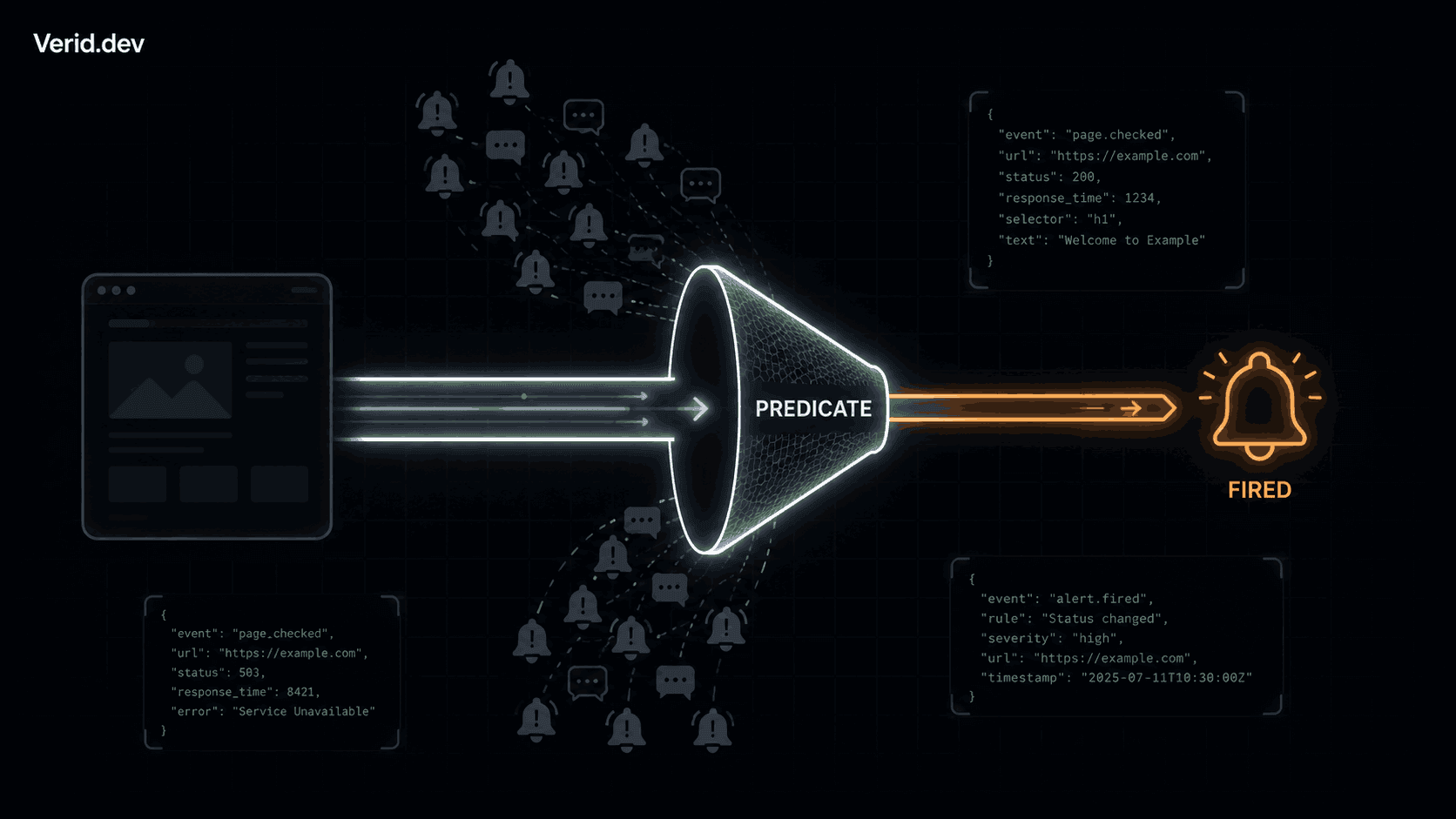
Stop Monitoring Noise: How Predicate-Based Alerting Saves Your Sanity
There is a particular kind of Monday morning you learn to dread after running monitors for a while. You open Slack and find forty-seven alerts from the weekend. Forty-five of them are cookie banners that rotated, a timestamp that ticked over, or an ad slot that refreshed. Two of them matter. You cannot tell which two without reading all forty-seven.
That is alert fatigue, and it is not a personality problem. It is an architectural one.
The architecture most monitoring tools use fires on raw change: any byte that differs from the last snapshot triggers a notification. That made sense once, when "did the page change at all?" was a useful question. It does not make sense anymore, because modern web pages change constantly in ways that have nothing to do with what you are actually watching.
Predicate-based alerting flips the model. Instead of "fire when anything changes," you define a precise condition, and the monitor only fires when that condition is true. Nothing else gets through.
What a Predicate Actually Is
In logic, a predicate is a statement that evaluates to true or false given some input. In web monitoring, it is the same idea applied to the diff between two runs of your monitor.
You extract a specific field. The system compares the new value to the previous one. Your predicate evaluates that comparison. If it returns true, the alert fires. If it returns false, the run is logged silently and nothing is delivered to you.
A simple example: you are monitoring a competitor's product page and you want to know when their price drops by at least five percent. The predicate is:
{
  "type": "field_decreases_by_percent",
  "field": "price",
  "threshold": 5
}
If the price goes from $100 to $96, that is a 4% drop, so the predicate is false and you hear nothing. If it goes to $94, that is a 6% drop, the predicate is true, and you get a webhook. The price bouncing between $100 and $101 because of currency rounding? Silent. A cookie banner loading half a second later than last time? Completely irrelevant, because you never extracted it in the first place.
This is the difference between state monitoring and screenshot diffing.
Why Screenshot Diffing Fails at Scale
Visual monitoring tools compare page screenshots pixel by pixel. Any visual change triggers an alert. In theory this sounds comprehensive. In practice it means you get notified every time:
- A banner ad rotates to a different creative
- An animated element is captured mid-transition
- A "Last updated" timestamp increments
- A cookie consent overlay appears or disappears
- A font loads slightly differently across two runs
None of those things matter to your actual monitoring goal. But the tool cannot know that, because it is comparing images rather than values. It has no concept of which parts of the page you care about.
Predicate-based monitoring sidesteps this entirely. You extract only the fields you care about, using CSS selectors, XPath, JSONPath, regex, or even an LLM prompt for pages where the markup keeps shifting. The monitor never even looks at the rest of the page. And then your predicate evaluates only against those extracted fields. The cookie banner is invisible to the entire pipeline.
The Five-Stage Pipeline
Understanding why predicate-based monitoring is quiet by default requires understanding the loop it runs.
Stage 1: Fetch. The monitor retrieves the URL on your configured schedule. Static fetch runs first. If the extraction returns empty fields (JavaScript-rendered content), it automatically retries with a headless browser. Bot-protected sites escalate further to a residential proxy.
Stage 2: Extract. Structured fields are pulled from the response. You define which fields using one of six methods: CSS selector, XPath, JSONPath, regex, full-page hash, or an LLM prompt. The output is always typed values, never raw HTML.
Stage 3: Diff. Each field's new value is compared against the value stored from the previous successful run. The system records exactly which fields changed and what the before/after values were.
Stage 4: Predicate evaluation. Your diff_predicate is evaluated against the diff. This is the gate. If it returns false, the run is recorded and the pipeline stops here. No delivery, no notification.
Stage 5: Deliver. Only if the predicate returned true does a delivery go out. You can route to a signed webhook, a Slack channel, Discord, or email. Every webhook is HMAC-signed so your endpoint can verify it genuinely came from the monitor.
The predicate stage is why this approach is quiet by default. Most runs never reach stage five.
The Nine Predicate Types
Verid's change detection supports nine predicate types, covering the common alerting patterns developers actually need. The full reference lives in the predicates documentation.
Any field changes
{ "type": "any_field_changes" }The broadest predicate. Fires whenever any extracted field differs from the previous run. Useful when you genuinely want to know about any change to a small set of important fields, or as a starting point before you know which field will change.
Specific field changes
{ "type": "field_changes", "field": "version" }Fires only when the named field changes. Other fields can shift freely without triggering delivery. Good for version bump monitors, status text changes, or anything where the field identity matters more than the magnitude of change.
Field increases by percentage
{
  "type": "field_increases_by_percent",
  "field": "price",
  "threshold": 10
}
Fires when a numeric field rises by at least the specified percentage. Useful for stock alerts, traffic spikes, or any metric where a significant upward move is the signal.
Field decreases by percentage
{
  "type": "field_decreases_by_percent",
  "field": "price",
  "threshold": 5
}
The mirror predicate. This is the classic repricing trigger: notify a workflow when a competitor's price drops by five percent or more. Small rounding changes never reach you.
Field increases by absolute value
{
  "type": "field_increases_by_absolute",
  "field": "open_issues",
  "threshold": 50
}
Fires when a field increases by at least a fixed amount rather than a percentage. Useful for issue counts, comment counts, sitemap URL counts, or any numeric that makes more sense in absolute terms.
Field decreases by absolute value
{
  "type": "field_decreases_by_absolute",
  "field": "stock_count",
  "threshold": 10
}
The downward version. Useful for inventory monitoring, follower counts, or any countable where a significant drop is meaningful.
Field matches regex
{
  "type": "field_matches_regex",
  "field": "status",
  "pattern": "^(error|failed|critical)"
}
Fires when the new value of a field matches a regular expression. Practical for catching error states, specific keywords appearing in a content field, or format changes. Uses JavaScript regex syntax; remember to escape backslashes in JSON.
Field equals value
{
  "type": "field_equals",
  "field": "availability",
  "value": "In Stock"
}
Fires when a field reaches an exact literal value. The restock alert archetype: wait until availability is exactly "In Stock," then fire. Case-sensitive for strings.
Composite (AND / OR)
{
  "type": "composite",
  "operator": "AND",
  "conditions": [
    { "type": "field_decreases_by_percent", "field": "price", "threshold": 5 },
    { "type": "field_equals", "field": "availability", "value": "In Stock" }
  ]
}
Combine any predicates with AND or OR logic. You can nest composites inside composites for arbitrarily complex rules. The example above fires only when a price drops by five percent AND the item is in stock simultaneously, which is far more useful than either condition alone.
Predicate Comparison Table
| Predicate type | Fires when | Common use case |
|---|---|---|
any_field_changes | Any extracted field differs | Broad change detection |
field_changes | One specific field differs | Version bumps, status changes |
field_increases_by_percent | Numeric field rises by N% | Traffic spikes, price surges |
field_decreases_by_percent | Numeric field drops by N% | Competitor price drops |
field_increases_by_absolute | Numeric field rises by fixed N | New issues, new URLs in sitemap |
field_decreases_by_absolute | Numeric field drops by fixed N | Inventory drops |
field_matches_regex | New value matches a regex | Error states, keyword detection |
field_equals | New value equals a literal | Restock alerts, status transitions |
composite | AND / OR of other predicates | Multi-condition business rules |
Traditional Monitoring vs. Predicate-Based Monitoring
| Capability | Screenshot / byte-diff tools | Predicate-based monitoring |
|---|---|---|
| Alert granularity | Page-level or pixel-level | Field-level |
| False positives | High (ads, timestamps, banners) | Low (only your condition) |
| Alert logic | "Did anything change?" | "Did this specific thing cross this threshold?" |
| Composable rules | No | Yes, with AND / OR nesting |
| Structured payload | No (image diff or raw text) | Yes (before/after values per field) |
| Quiet by default | No | Yes |
A Real Example: Dependency Release Monitor
One of the most common and underappreciated monitoring tasks for developers is watching upstream package versions. If React ships a new release and your CI does not know until someone manually checks, that is a gap you can close in about two minutes.
Here is the full monitor creation request for a GitHub release tracker, using the Verid REST API:
curl -X POST https://api.verid.dev/v1/monitors \
  -H "Authorization: Bearer $VERID_API_KEY" \
  -H "Content-Type: application/json" \
  -d '{
    "name": "React New Releases",
    "url": "https://api.github.com/repos/facebook/react/releases/latest",
    "schedule_interval_seconds": 3600,
    "extract_config": {
      "method": "json_path",
      "fields": {
        "tag_name": "$.tag_name",
        "published_at": "$.published_at"
      }
    },
    "diff_predicate": {
      "type": "field_changes",
      "field": "tag_name"
    },
    "deliveries": [
      {
        "type": "webhook",
        "url": "https://your-app.com/webhooks/verid"
      }
    ]
  }'
The monitor polls the GitHub API every hour. The predicate fires only when tag_name changes. The published_at field is extracted too, so it appears in the diff payload for context, but it does not trigger delivery on its own.
When a new release ships, your endpoint receives:
{
  "id": "del_01H...",
  "version": "2026-05-01",
  "monitor_id": "uuid",
  "fired_at": "2026-06-01T09:31:00Z",
  "diff": {
    "fields_changed": ["tag_name"],
    "before": { "tag_name": "v18.3.0" },
    "after":  { "tag_name": "v19.0.0" }
  },
  "monitor": {
    "url":  "https://api.github.com/repos/facebook/react/releases/latest",
    "name": "React New Releases"
  }
}
That payload is actionable without any parsing. You know what changed, what it was before, and what it is now.
A More Complex Example: Price Drop Plus In-Stock
Say you are tracking a product that frequently goes out of stock. A price drop on an out-of-stock item is irrelevant. You want a notification only when the price drops and the item can actually be purchased.
A composite predicate with AND logic handles this precisely:
{
  "type": "composite",
  "operator": "AND",
  "conditions": [
    {
      "type": "field_decreases_by_percent",
      "field": "price",
      "threshold": 10
    },
    {
      "type": "field_equals",
      "field": "availability",
      "value": "In Stock"
    }
  ]
}
Both conditions must be true in the same run for delivery to fire. This kind of multi-condition logic would require a custom webhook consumer or external automation in most other monitoring setups. Here it lives entirely in the monitor configuration. See the competitor price tracking use case for a full walkthrough.
Verifying the Webhook Delivery
When a predicate fires and a webhook delivery goes out, every request is signed with HMAC-SHA256. The signature sits in the Verid-Signature header in the format t={timestamp},v1={signature}.
You should always verify this before trusting the payload. A Node.js verification function from the webhooks documentation:
import { createHmac, timingSafeEqual } from 'crypto';

function verifyWebhook(
  header: string,
  rawBody: string,
  secret: string,
  toleranceSecs = 300,
): boolean {
  const parts = Object.fromEntries(
    header.split(',').map((p) => p.split('=')),
  );
  const timestamp = parseInt(parts['t'] ?? '0', 10);
  const signature = parts['v1'];

  if (!timestamp || !signature) return false;
  if (Math.abs(Date.now() / 1000 - timestamp) > toleranceSecs) return false;

  const expected = createHmac('sha256', secret)
    .update(`${timestamp}.${rawBody}`)
    .digest('hex');

  return timingSafeEqual(Buffer.from(expected, 'hex'), Buffer.from(signature, 'hex'));
}
The 300-second tolerance guards against replay attacks. Equivalent verification snippets for Python, Ruby, Go, and PHP are available in the webhooks docs.
First-Run Behavior and Other Practical Notes
A few things worth knowing before you ship your first monitor:
The first run never fires. There is no previous run to compare against, so the baseline is established silently. This is expected behavior, not a bug.
Numeric string parsing. For percent and absolute predicates, Verid will try to parse strings like "$1,299.00" or "1,450" as numbers. It is cleaner to strip currency symbols in your extractor when you can, because it removes ambiguity.
Boolean fields. The field_equals predicate distinguishes JSON booleans from strings. If your extractor returns the string "true", that is not equal to the JSON boolean true. Worth keeping in mind when monitoring APIs that serialize booleans inconsistently.
Composite nesting. Composite conditions can contain other composites. You can build (A AND B) OR C by nesting one composite inside another. The depth limit is generous enough that most real-world business rules fit within a single config.
When to Use Which Approach
Not every monitor needs a precise predicate. Here is a quick heuristic:
- If you want to know whether a page changed at all and false positives are tolerable,
any_field_changesis fine. - If you are watching a structured data source (an API, a JSON endpoint, a known HTML pattern), use a field-specific predicate.
- If the signal is numerical and the magnitude matters, use the percent or absolute variants.
- If you want multiple conditions to be true simultaneously, reach for composite with AND.
- If any one of several conditions is enough, composite with OR is the right shape.
The use cases directory has thirty-plus worked examples across competitive pricing, dependency tracking, regulatory filings, SERP monitoring, inventory restocks, and API contract drift, each showing which extraction method and predicate combination makes sense.
FAQ
What is predicate-based alerting?
Predicate-based alerting is a monitoring approach where a notification fires only when a specific logical condition, called a predicate, evaluates to true against the diff between two monitoring runs. Rather than alerting on any change to a page, you define exact rules like "price dropped by more than five percent" or "status field equals 'error'" and only those conditions produce alerts.
How does predicate-based alerting reduce alert fatigue?
Alert fatigue comes from too many notifications that do not require action. Predicate-based alerting reduces this by filtering at the monitor level: changes that do not satisfy your defined condition are logged but never delivered. Cookie banners, ad rotations, and timestamp changes produce no notifications because the fields you care about are not affected.
Can I combine multiple conditions in a single monitor?
Yes. Composite predicates let you combine any number of conditions with AND or OR logic, and you can nest composites inside each other. A common pattern is using AND to require that a price dropped and the item is in stock simultaneously, so neither condition alone causes a spurious alert.
How do I get started with predicate-based monitoring?
Start a 14-day free trial at verid.dev (no credit card required), grab your API key, and follow the quickstart guide. The trial includes unlimited monitors, 200 runs, and full webhook delivery. The recipes section has copy-paste configs for GitHub release tracking, crypto price alerts, and more, each ready to drop into your first monitor.
About the author

Software Engineer & Technical Writer
A software engineer and technical writer, Hanzala focuses on developer experience at Verid: SDKs, API reference, and step-by-step guides. He writes about change detection, scheduling, and alert design for teams automating web data.
More from HANZALA SALEEM →Related posts
API Contract Monitoring: How to Catch Breaking Changes Before They Hit Production
Learn how API contract monitoring catches breaking changes before production. Schema drift, field-level diff, and continuous JSON API monitoring explained.
Read the post →monitoringHow to Monitor Job Listings for Keywords and Get Instant Alerts
Learn how to track new job postings automatically using Verid. Set keyword filters, configure smart alerts, and get notified the moment a match appears.
Read the post →monitoringAPI Monitoring vs Scraping: Why the Loop Is the Product
Discover why API monitoring outperforms scraping. Learn how Verid.dev simplifies change detection with continuous monitoring and webhooks.
Read the post →monitoringXPath Tutorial: A Practical Guide for Web Scraping and Monitoring
Learn XPath syntax, axes, functions, and real scraping examples. Discover how to use XPath for website monitoring with Verid's change detection API.
Read the post →