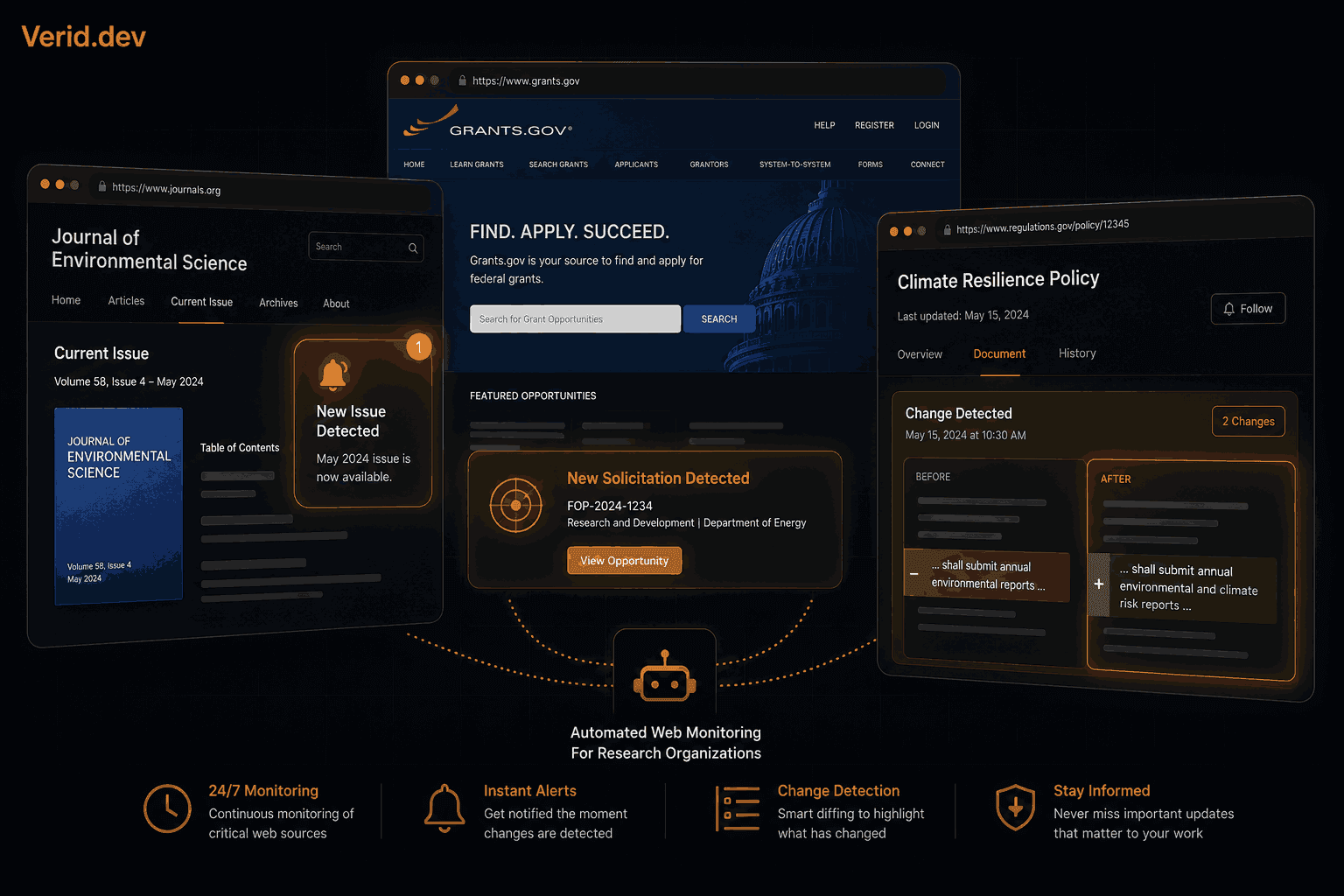
Automated Web Monitoring for Research Teams: Journals, Grants, and Policy Pages
Research coordination carries a monitoring burden most teams don't talk about openly. Somebody on every academic team, policy unit, or nonprofit research office has the unofficial job of checking the same twenty URLs every morning - the NSF solicitations page, the NIH notice board, a handful of journal landing pages, three or four agency policy documents. It's tedious, it doesn't scale, and it's exactly the kind of task that falls apart the moment that person goes on leave.
The pages being watched aren't trivial. A new NSF solicitation that your lab discovers two weeks late is two weeks lost from a preparation window that might only be six weeks total. A revised policy on an NIH public access page affects how your team reports publications for funded grants. A new accepted article in a high-impact journal could shift a lit review or a grant justification argument. This information matters, and the manual approach to tracking it is genuinely unreliable.
This guide shows how to replace that manual process with an automated monitoring setup using Verid.dev - a developer-first web change detection API that extracts structured fields from any URL and sends an alert only when a predicate you define evaluates to true. The implementation examples use the real Verid REST API and Node.js SDK, verified against Verid's documentation.
Why Manual Monitoring Breaks Down for Research Teams
The academic and public policy web is not built for systematic tracking. Federal agencies publish updates on their own timelines with no announcements. Journal publishers don't expose consistent RSS feeds across their catalog. Government policy pages accumulate amendments quietly, without any notification mechanism for external readers.
Three specific failure modes come up repeatedly for research teams trying to monitor this landscape manually:
The check never happens consistently. Someone is sick, someone is traveling, deadlines are stacking up. The page doesn't get checked during the window that matters. A new solicitation appears and disappears from the "recently posted" view before anyone notices it.
The alert comes too late. Many grant solicitations on NSF and NIH have fixed submission windows measured in weeks. A week of delay on discovery is a week lost from writing.
Noise accumulates. Screenshot-based monitoring tools fire alerts every time a cookie banner loads, a timestamp updates, or a navigation element shifts. After a few days of irrelevant alerts, people stop reading them - which defeats the point.
The solution isn't a better manual process. It's removing the human from the loop for the checking part, while keeping humans in the loop for the acting part.
What Research Teams Actually Need to Monitor
The monitoring targets for academic and policy organizations cluster into a predictable set:
| Source Type | Examples | Signal to Watch |
|---|---|---|
| Federal grant portals | Grants.gov, NSF, NIH REPORTER | New solicitations, deadline changes |
| Government policy pages | OSTP, EPA, OMB, FDA | Effective date changes, new guidance |
| Academic journal sites | Nature, PLOS ONE, Elsevier | New issues, section updates |
| Preprint servers | arXiv, bioRxiv, SSRN | New submissions in a topic area |
| Regulatory registers | Federal Register, EUR-Lex | Comment periods opening, rule finalization |
| Research dataset portals | NIH Data Sharing, DataCite | New dataset releases |
Each of these requires a slightly different monitoring approach depending on whether the source renders content via JavaScript, exposes structured JSON, or is a static HTML page.
How Verid Works
Every Verid monitor runs the same five-stage loop on a schedule you set:
- Fetch - A static HTTP request runs first. If the target page is JavaScript-rendered or bot-protected, Verid automatically escalates to a headless browser, then to a residential proxy if needed. No configuration required.
- Extract - One of six extraction methods pulls named fields from the response: CSS selectors, XPath, JSONPath, regex, full-page hash, or AI prompt.
- Diff - Extracted values are compared field-by-field against the previous successful run.
- Predicate - Your rule evaluates against the diff. Nine predicate types are available, including
field_changes,field_increases_by_absolute, and composite AND/OR combinations. If the predicate returns false, the run is logged silently. - Deliver - An HMAC-signed webhook, Slack message, Discord notification, or email goes out. Deliveries retry up to 6 times with exponential backoff, then land in a dead-letter queue.
The predicate stage is the key difference from screenshot tools. Your research team watching 15 policy pages doesn't want 15 daily emails about "the page changed." They want one email when the policy effective date actually moves.
Monitoring Grant Opportunities
Grant portals are the highest-stakes monitoring target for most research organizations. Hourly checks, which use about 720 runs a month per page (Starter's 5,000 runs cover about 6 such pages), give you a real timing advantage over teams relying on manual checks or broad portal email digests.
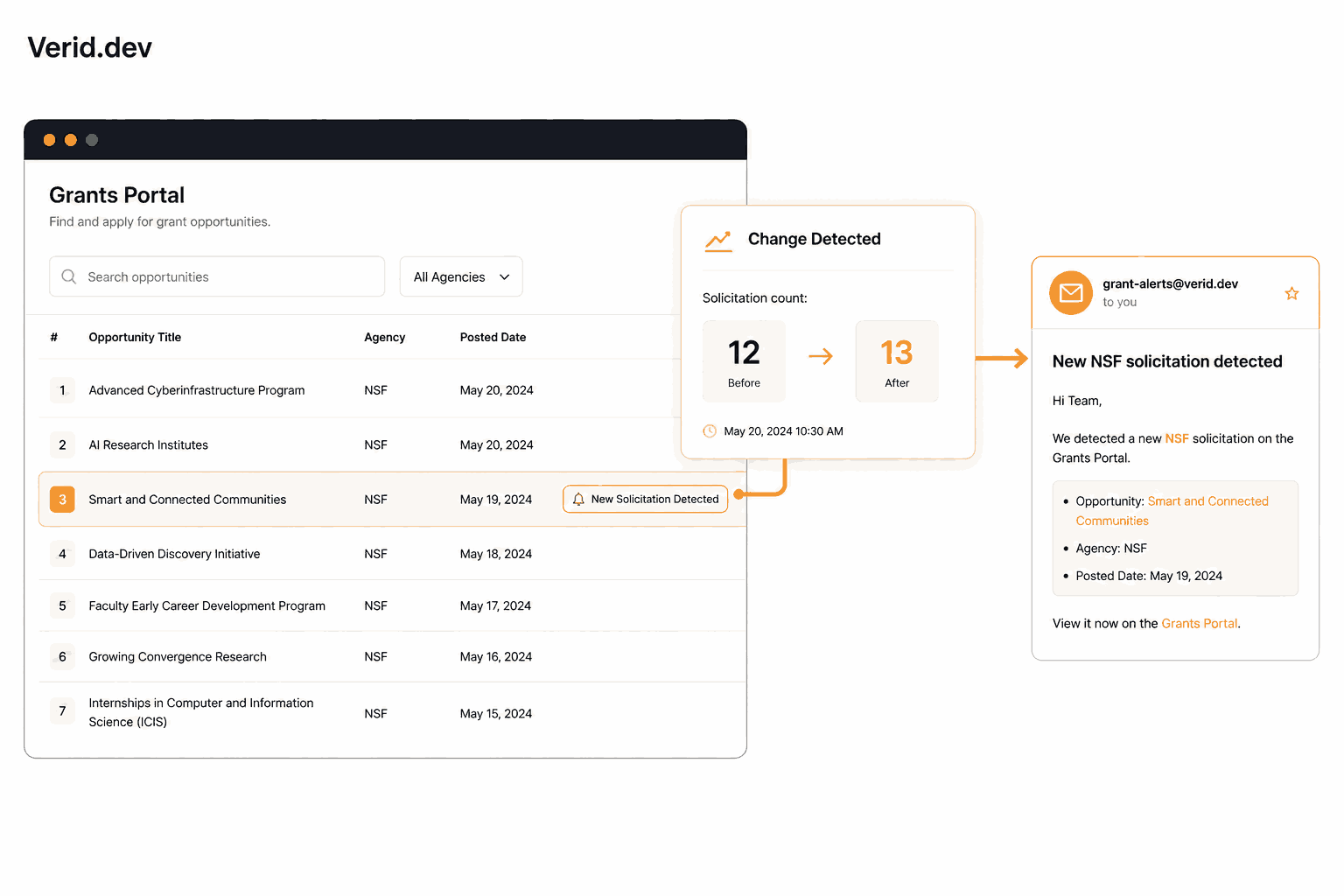
For rendered HTML portals like NSF's funding pages, AI prompt extraction adapts to layout changes without requiring HTML knowledge. You describe what you want, Verid extracts it, and the predicate fires only when a new solicitation appears - not when a nav element shifts or a footer link changes.
curl -X POST https://api.verid.dev/v1/monitors \
  -H "Authorization: Bearer $VERID_API_KEY" \
  -H "Content-Type: application/json" \
  -d '{
    "name": "NSF CISE Solicitations Watch",
    "url": "https://www.nsf.gov/funding/programs.jsp?org=CISE",
    "schedule_interval_seconds": 86400,
    "fetch_mode": "browser",
    "extract_config": {
      "method": "prompt",
      "prompt": "Count the total number of active funding solicitations listed on this page and return it as solicitation_count. Extract the title of the most recently posted solicitation as latest_solicitation.",
      "schema": {
        "solicitation_count": "number",
        "latest_solicitation": "string"
      }
    },
    "diff_predicate": {
      "type": "field_increases_by_absolute",
      "field": "solicitation_count",
      "threshold": 1
    },
    "deliveries": [
      { "type": "email", "to": "grants@yourlab.edu" }
    ]
  }'
fetch_mode: "browser" is set because NSF's funding pages use JavaScript rendering. Verid routes through a headless browser automatically when this is set, so CSS selectors and prompt extraction both see the fully rendered DOM.
The same pattern applies to Grants.gov. For a research organization monitoring multiple topic areas, you can create one monitor per keyword search URL - for instance, separate monitors for biology, engineering, and social sciences solicitations - each with its own email delivery:
import { VeridClient } from '@verid.dev/sdk';

const client = new VeridClient({ apiKey: process.env.VERID_API_KEY });

await client.monitors.create({
  name: 'Grants.gov - Social Sciences Opportunities',
  url: 'https://www.grants.gov/search-grants?oppStatuses=forecasted%7Cposted&category=SC',
  schedule_interval_seconds: 86400,
  fetch_mode: 'browser',
  extract_config: {
    method: 'prompt',
    prompt: 'Count the number of grant opportunities listed on this page and return it as opportunity_count. Extract the title of the first listed opportunity as top_opportunity.',
    schema: {
      opportunity_count: 'number',
      top_opportunity: 'string',
    },
  },
  diff_predicate: {
    type: 'field_increases_by_absolute',
    field: 'opportunity_count',
    threshold: 1,
  },
  deliveries: [
    { type: 'email', to: 'grants@yourlab.edu' },
  ],
});
Monitoring Government Policy Pages
Policy pages from agencies like OSTP, NIH, EPA, or the Office of Management and Budget share one maddening characteristic: they update without announcements. The revision lives in amended paragraph text, not in a new URL or a press release.
Verid's regulatory filing monitoring pattern handles this with prompt-based extraction targeting the effective date of the most recent revision. When that specific field changes, the alert fires. Nav redesigns, footer updates, and banner changes have no effect on it.
curl -X POST https://api.verid.dev/v1/monitors \
  -H "Authorization: Bearer $VERID_API_KEY" \
  -H "Content-Type: application/json" \
  -d '{
    "name": "NIH Public Access Policy",
    "url": "https://publicaccess.nih.gov/policy.htm",
    "schedule_interval_seconds": 86400,
    "extract_config": {
      "method": "prompt",
      "prompt": "Extract: (1) the effective date of the most recent revision or amendment on this page as an ISO date string, (2) the title or section of the most recently changed content, (3) a one-sentence summary of the current policy statement.",
      "schema": {
        "effective_date": "string",
        "revised_section": "string",
        "summary": "string"
      }
    },
    "diff_predicate": {
      "type": "field_changes",
      "field": "effective_date"
    },
    "deliveries": [
      { "type": "email", "to": "compliance@yourlab.edu" },
      { "type": "slack", "webhook_url": "https://hooks.slack.com/services/YOUR/HOOK" }
    ]
  }'
When this predicate fires, the webhook payload includes before and after values for every changed field. Your team sees exactly what the effective date was and what it changed to - without visiting the page or diffing documents manually.
For high-priority policy pages where any change matters (not just effective date changes), run a second backup monitor using method: "full_page" with any_field_changes. This catches structural page rewrites that might not produce a different effective date even though content shifted. Review full-page hash alerts weekly rather than acting on them immediately.
Monitoring Academic Journals
Journal monitoring is structurally messier than grant or policy monitoring because there's no consistent HTML layout across publishers. A selector that works on a Nature section landing page won't transfer to an Elsevier journal or a PLOS ONE subject area page.
Prompt-based extraction handles this variation cleanly. For preprint servers that expose structured feeds, regex extraction counting feed entries is more precise.
import { VeridClient } from '@verid.dev/sdk';

const client = new VeridClient({ apiKey: process.env.VERID_API_KEY });

// Monitor a journal section for newly listed articles
await client.monitors.create({
  name: 'Nature Climate Change - New Articles',
  url: 'https://www.nature.com/nclimate/articles',
  schedule_interval_seconds: 86400,
  fetch_mode: 'browser',
  extract_config: {
    method: 'prompt',
    prompt: 'Count the number of article entries listed on this page and return it as article_count. Extract the full title of the first listed article as latest_article.',
    schema: {
      article_count: 'number',
      latest_article: 'string',
    },
  },
  diff_predicate: {
    type: 'field_changes',
    field: 'latest_article',
  },
  deliveries: [
    { type: 'email', to: 'research@yourlab.edu' },
  ],
});
For arXiv, which exposes per-subject RSS feeds in XML format, regex extraction against the raw feed is a lighter-weight and more reliable choice:
curl -X POST https://api.verid.dev/v1/monitors \
  -H "Authorization: Bearer $VERID_API_KEY" \
  -H "Content-Type: application/json" \
  -d '{
    "name": "arXiv cs.AI New Submissions",
    "url": "https://arxiv.org/rss/cs.AI",
    "schedule_interval_seconds": 86400,
    "extract_config": {
      "method": "regex",
      "fields": {
        "entry_count": "<item>"
      }
    },
    "diff_predicate": {
      "type": "field_increases_by_absolute",
      "field": "entry_count",
      "threshold": 1
    },
    "deliveries": [
      { "type": "webhook", "url": "https://your-system.edu/hooks/arxiv" }
    ]
  }'
The regex method counts occurrences of <item> in the raw feed body. That count increases whenever new papers appear. The predicate fires the moment any new entry is present compared to the previous run.
Recommended Monitoring Intervals by Source Type
Polling frequency should match the actual update cadence of the source. Checking a policy page every 15 minutes wastes API budget and adds no value - those pages update monthly at most.
| Source Type | Recommended Interval | Runs per Month (per page) |
|---|---|---|
| Federal Register rules | Daily (86,400s) | About 30 |
| NSF / NIH solicitations | Daily (86,400s) | About 30 |
| Agency policy pages | Daily (86,400s) | About 30 |
| Academic journal sections | Daily (86,400s) | About 30 |
| Preprint server feeds | Every 6 hours (21,600s) | About 120 |
| Grant deadline pages (near close) | Hourly (3,600s) | About 720 |
| High-priority regulatory pages | Every 15 minutes (900s) | About 2,880 |
The 14-day free trial supports unlimited monitors and 200 runs, about 14 sources checked daily for the trial - enough to test the most critical sources for a small research team without any cost commitment. After it, the Lite plan ($9 a month, 1,000 runs) covers about 30 sources checked daily.
Best Practices
Name monitors to include the agency and what's being tracked. "NIH Public Access Policy - Effective Date" is immediately scannable in an inbox. "Policy Monitor 3" is not.
Route grant alerts to where decisions happen. Slack delivery into a #grants-watch channel is more actionable than email for teams that coordinate in Slack. Verid's Slack and webhook delivery options post the before/after diff directly into the channel so no one has to click through to a dashboard to see what changed.
Archive webhook payloads for compliance purposes. For federally funded research, treating each webhook as a timestamped record creates a paper trail showing when your team learned of a policy change. This is useful during grant reporting cycles and audits.
Trigger a manual run immediately after setup. The Verid dashboard includes a Run Now function. Use it after creating any monitor to confirm your extraction is pulling the right fields before the first scheduled check runs.
Test your webhook endpoint. If you're routing alerts to your own system, use a tool like Webhook.site to inspect the signed payload before wiring it into your workflow. Verify the Verid-Signature header as described in the webhooks documentation.
Common Mistakes
Using full-page hash on dynamic grant portals. Grants.gov and most federal agency portals include dynamic timestamps, session variables, and rotated banners in their rendered HTML. A full-page hash monitor fires on every single check, regardless of whether any funding content changed. Use prompt or field-specific extraction instead.
Setting intervals too short for slow-moving sources. Hourly checks on a policy page that updates twice a year are unnecessary. Match the interval to how frequently the source actually changes.
Monitoring a portal homepage instead of the specific page. The NSF homepage is not where solicitations live. The NIH homepage doesn't list new NOFOs. Monitor the specific program, directorate, or listing page that contains the content you care about.
Sending all alerts to a single email. When grant alerts, policy alerts, and journal alerts all arrive in one inbox without routing logic, they get ignored together. Set up separate monitors with deliveries routed to the people or channels responsible for each type.
Conclusion
Most research teams are one automated monitoring setup away from recovering meaningful time from their coordination workflows. The pages that matter - grant portals, policy documents, journal landing pages, preprint feeds - are all reachable via HTTP, and Verid's extraction pipeline handles the structural diversity across them without requiring separate tooling for each source.
A 14-day free Verid trial gives you unlimited monitors and 200 runs, enough for about 14 sources checked daily while you test. That covers the top-priority funding or policy sources for most labs and organizations immediately, with no credit card required.
Start a free trial and get your API key at verid.dev or walk through the quickstart documentation to see the monitor creation flow before signing up.
Frequently Asked Questions
What is web monitoring for research teams?
Web monitoring for research teams is the automated process of tracking specific pages - grant portals, policy documents, journal sites, and regulatory registers - for meaningful changes, then sending an alert when something important updates. A tool like Verid checks those pages on a schedule you define and only notifies you when a predicate you specify evaluates to true: a new solicitation appeared, a policy effective date changed, or a new article was listed. The goal is to replace manual daily page checks with a reliable, low-noise automated system.
How do I monitor NSF and NIH grant pages automatically?
Use a web change detection API like Verid. Point a monitor at the specific program or solicitations page for the NSF directorate or NIH institute you follow, configure prompt-based AI extraction to count listed opportunities, and set a field_increases_by_absolute predicate with a threshold of 1. You receive an email or webhook the moment a new solicitation appears. Daily check intervals are sufficient for most grant portal monitoring and use about 30 runs a month per page, well inside the 200 runs in Verid's 14-day free trial and the 1,000 a month on the Lite plan.
Can I monitor government policy pages without an API?
Yes. Most federal agency policy pages don't expose a developer API, but they're all reachable via HTTP. Verid's prompt-based extraction lets you describe what field to pull from the page - such as the effective date of the most recent policy revision - and tracks that field over time. When it changes, you get an alert with the before and after values. The regulatory filings use case on Verid covers this pattern in detail, including cURL and Node.js SDK examples.
How do I avoid false alerts when monitoring research websites?
Use predicate-based alerting rather than full-page hashing. Full-page hash monitors fire whenever any byte on the rendered page changes, including timestamps, session tokens, and rotating banners. Setting a field_changes or field_increases_by_absolute predicate on a specific extracted value - solicitation count, journal issue number, or policy effective date - means alerts only fire when the content you actually care about moves. See the predicates documentation for the full list of available predicate types.
About the author

Software Engineer & Technical Writer
Software engineer and technical writer, Hanzala works on both Verid’s product and its docs. He’s most at home explaining APIs, webhooks and selector syntax in plain language, with examples you can actually run.
More from HANZALA SALEEM →Related posts
Free Website Change Monitors Compared (No Card Required)
Compare free website change monitors that need no credit card. Real limits, check frequency, and which tool actually fits your use case.
Read the post →visual monitoringVisual Regression Testing vs Visual Monitoring: Which Do You Need?
Visual regression testing catches bugs before release. Visual monitoring catches changes after deployment. Learn the difference and which one you need.
Read the post →comparisonApify Alternative for Scheduled Website Monitoring
Compare Apify Actors to a dedicated change monitoring API. See when building an Actor makes sense, and when webhooks on a rule get you there faster.
Read the post →AiHow to Feed AI Agents Fresh Web Data Without Re-Scraping Everything
How AI agents and RAG systems stay fresh without re-scraping entire sites: change detection, webhooks, and incremental updates explained.
Read the post →