
Google Alerts Alternative for Developers: Structured Monitoring with Webhooks
Google Alerts was built for journalists and casual users who want email digests when Google indexes a new article. It was never built for developers. There is no API. There are no webhooks. The output is unstructured HTML in an email. You cannot filter by a specific field value, set a threshold, or route a result into any pipeline without writing a parser yourself.
If you have ever tried to use Google Alerts inside an automated workflow, you already know this. The alert arrives late, it includes irrelevant results, and you cannot do anything useful with it programmatically.
This article covers what developers actually need instead, and how Verid closes the gap between raw web monitoring and production-grade automation.
Why Developers Outgrow Google Alerts Fast
Google Alerts works like this: Google crawls the web, indexes a page, matches it against your keyword, then batches it into an email. That email arrives anywhere from hours to days later.
That model has three problems for anyone building something on top of it:
No programmatic delivery. There is no API to subscribe to results. There is no webhook endpoint. The only output is an email or an RSS feed, which you then have to poll, parse, and deduplicate yourself.
No structured data. The result is a link and a snippet. You get no extracted field, no typed value, no before/after diff. If you want to know that a price moved from $49 to $39, Google Alerts cannot tell you that. It just tells you the page was indexed.
No predicate filtering. Every match triggers an alert. You cannot say "only notify me if the stock field changes to In Stock" or "only fire if the version field changes." Signal-to-noise is entirely your problem.
This is not a criticism. Google Alerts is a free keyword-matching email tool. The problem is that most "Google Alerts alternatives" articles recommend other email tools that have the same structural limitations, just with nicer dashboards.
What Developers Actually Need
When a developer says they want a Google Alerts alternative, they usually mean one of three things:
- Monitor a specific webpage or API endpoint for a meaningful change in a specific field
- Get notified via webhook so the alert can trigger a downstream action automatically
- Not have to maintain the scheduler, state storage, retry logic, and diff comparison themselves
These are not brand monitoring requirements. They are infrastructure requirements. The solution is not a social listening tool; it is a web change detection API with structured extraction and predicate-based delivery.
How Verid Works
Verid is a developer-first web change detection API. You define a monitor with a URL, an extraction method, a predicate, and a delivery channel. Verid runs the whole loop on a schedule you set and fires your webhook only when your rule evaluates to true.
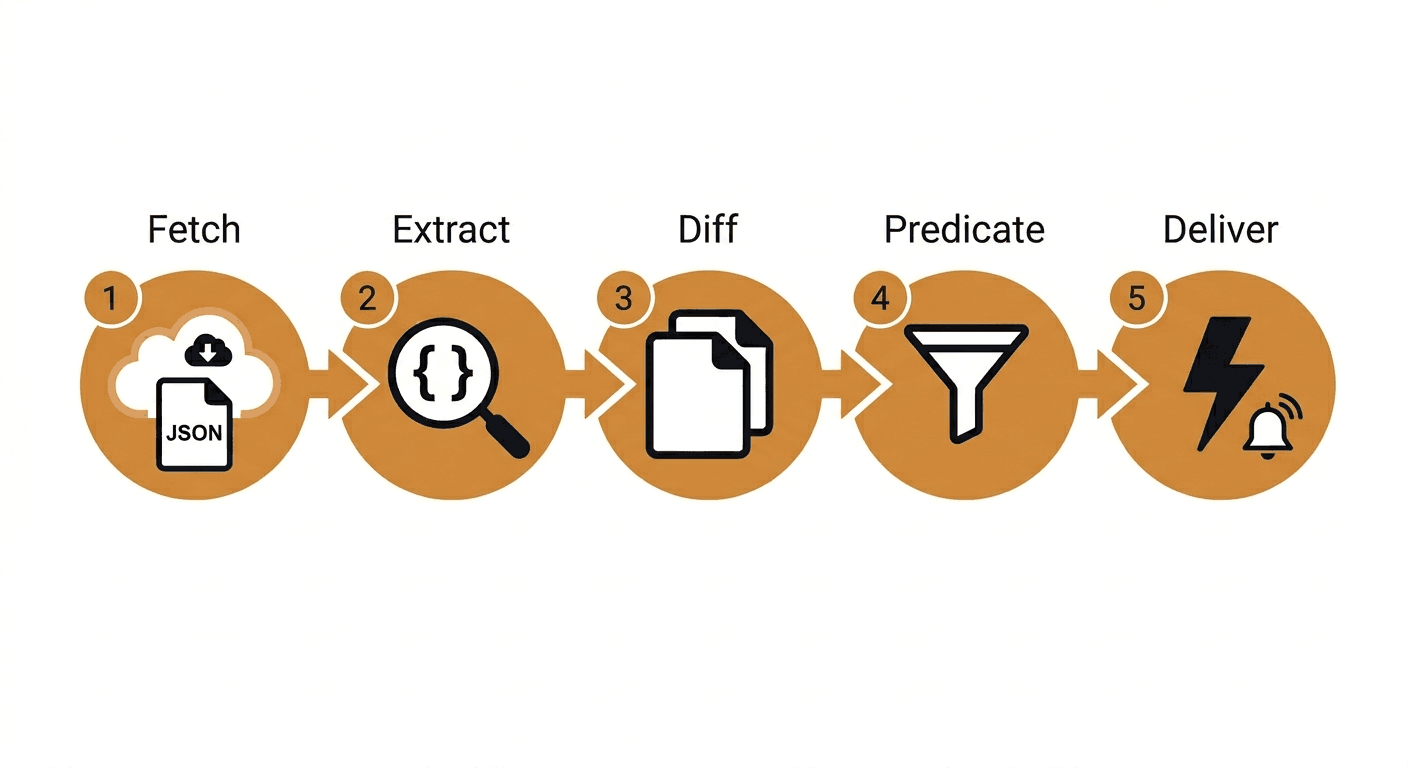
The pipeline has five stages:
- Fetch. Static fetch first. If extraction returns empty, Verid auto-escalates to a headless browser, then to a residential proxy for bot-protected sites. You do not configure this manually.
- Extract. Pull a typed field using CSS selectors, XPath, JSONPath, regex, full-page hash, or a plain-English LLM prompt. The output is always a named field with a typed value, not raw HTML.
- Diff. Verid compares the current field value against the last successful run and records the before/after pair.
- Predicate. Evaluate your rule. Did the price drop 10%? Did the version string change? Did the stock field match a regex? If the rule returns false, nothing is sent. If it returns true, Verid proceeds to delivery.
- Deliver. A signed webhook POST, a Slack message, a Discord message, or an email, with 6 automatic retries and exponential backoff. Nothing is silently dropped.
Setting Up a Monitor: Code Example
The following example creates a monitor that watches the GitHub React repository's latest release and fires a webhook the moment the version field changes. This uses the official Node.js SDK.
npm install @verid.dev/sdkimport { VeridClient } from '@verid.dev/sdk';
const client = new VeridClient({
apiKey: process.env.VERID_API_KEY!,
});
const monitor = await client.monitors.create({
name: 'React New Releases',
url: 'https://api.github.com/repos/facebook/react/releases/latest',
schedule_interval_seconds: 3600,
extract_config: {
method: 'json_path',
fields: { tag_name: '$.tag_name' },
},
diff_predicate: { type: 'field_changes', field: 'tag_name' },
deliveries: [
{ type: 'webhook', url: 'https://your-app.com/webhooks/verid' },
],
});When the version changes, your endpoint receives a signed POST with the exact before/after diff:
{
  "diff": {
    "fields_changed": ["tag_name"],
    "before": { "tag_name": "v18.2.0" },
    "after":  { "tag_name": "v19.0.0" }
  },
  "monitor": {
    "url":  "https://api.github.com/repos/facebook/react/releases/latest",
    "name": "React New Releases"
  }
}
You should always verify the Verid-Signature header before processing. The Webhooks documentation has verification snippets in Node.js, Python, Ruby, Go, and PHP.
import { createHmac, timingSafeEqual } from 'crypto';

function verifySignature(header: string, rawBody: string, secret: string): boolean {
  const parts = Object.fromEntries(header.split(',').map((p) => p.split('=')));
  const ts = parseInt(parts['t'] ?? '0', 10);
  const sig = parts['v1'];
  if (!ts || !sig) return false;
  if (Math.abs(Date.now() / 1000 - ts) > 300) return false;

  const expected = createHmac('sha256', secret).update(`${ts}.${rawBody}`).digest('hex');
  return timingSafeEqual(Buffer.from(expected, 'hex'), Buffer.from(sig, 'hex'));
}
Google Alerts vs Verid: Comparison
| Capability | Google Alerts | Verid |
|---|---|---|
| API access | None | Full REST API + Node.js SDK |
| Webhook delivery | None | HMAC-signed, 6 retries, backoff, DLQ |
| Structured field extraction | None | CSS, XPath, JSONPath, regex, LLM |
| Before/after diff | None | Per-field diff on every run |
| Predicate filtering | None | 9 predicate types + AND/OR composites |
| JavaScript-rendered pages | No | Auto-escalates to headless browser |
| Bot-protected sites | No | Auto-escalates to residential proxy |
| Check frequency | Daily digest | Every minute, on any plan |
| Notification channels | Email only | Webhook, Slack, Discord, email |
| Free tier | Free (with limitations) | 14-day free trial, no card (unlimited monitors, 200 runs) |
Use Cases Where Verid Fits
Dependency release tracking. Monitor GitHub, npm, or PyPI endpoints with JSONPath extraction. Get a webhook before your CI pipeline discovers a breaking change. Verid has a ready-made recipe for this: GitHub Release Tracker.
Competitor price monitoring. Watch a product page with a CSS selector targeting the price element. Set a field_decreases_by_percent predicate with a threshold of 5, and only get notified when it actually drops. The competitor price tracking use case covers this in detail.
Restock alerts. Poll a product URL on a 15-minute interval. Extract the stock status field with a regex or CSS selector. Fire a webhook only when the value matches "In Stock". No noise from unrelated page changes.
API contract drift. Poll an upstream JSON API every 5 minutes. Extract the response schema fields you depend on. If any field disappears or changes type, you want to know before it hits production. See the JSON API field monitoring use case.
SERP monitoring. Watch a Google search result page for shifts in your ranking, featured snippet, or AI Overview. More on the SERP monitoring use case.
Regulatory filings. Government portals rarely offer APIs. Full-page hash detection on a specific filing page will catch any update, without you needing to define a precise selector in advance.
Best Practices
Use the most precise extraction method available. JSONPath is the right choice for JSON APIs. CSS selectors work well for stable HTML. Fall back to the LLM extractor only when selectors are likely to break across site redesigns, since natural-language prompts are more resilient but slightly slower.
Set a predicate before going live. A monitor without a predicate fires on every byte-level change. Cookie banners, timestamp updates, and ad rotations will all trigger delivery. Define the exact condition you care about up front.
Verify webhook signatures. Every Verid webhook includes a Verid-Signature header. Always validate it with HMAC before processing the payload. The check takes five lines of code and prevents spoofed requests. Full examples are in the Webhooks docs.
Start with the free trial. Verid's 14-day free trial includes unlimited monitors and 200 runs with no credit card required. That is enough to validate whether the extraction config and predicate are correct before you pay for anything.
Use composite predicates for precision. If you want to know when a product drops in price AND is in stock, use the composite predicate type with AND. Single-condition predicates are easier to debug; composites are more powerful.
Conclusion
Google Alerts is not going away, and it is fine for what it does: sending you an email when Google indexes a page containing your keyword. That is a narrow, specific use case.
For developers who need to monitor a URL programmatically, extract a typed field, diff it against the last known value, and route the result into a pipeline only when a meaningful condition is met, Google Alerts is not a tool. It is an obstacle.
Verid handles the full loop: fetch, extract, diff, predicate, and deliver. You write the config. Verid runs the infrastructure. The quickstart gets you to a working monitor in under two minutes, and the 14-day free trial does not require a credit card.
Start your free trial and run your first monitor today.
FAQs
Does Verid work on JavaScript-rendered pages?
Yes. Verid tries a static fetch first. If extraction returns empty fields, it automatically retries with a headless browser. Bot-protected sites fall through to a residential proxy. You do not need to configure this manually.
Can I monitor a JSON API endpoint, not just HTML pages?
Yes. Verid supports JSONPath extraction, which lets you pull a single field directly from a JSON API response. This works well for tracking GitHub releases, npm package versions, cryptocurrency prices, and any other JSON endpoint.
How is Verid different from a scraping API like ScrapingBee or Apify?
Scraping APIs return raw HTML or structured data, but you still have to schedule the fetch, store the previous state, compute the diff, evaluate your condition, and send the alert yourself. Verid handles all of that in one API call. You write the predicate; Verid runs the loop.
What happens if my webhook endpoint is down?
Verid retries failed deliveries up to 6 times with exponential backoff. If all retries fail, the delivery goes to a dead-letter queue. Nothing is silently dropped.
About the author

Software Engineer & Technical Writer
A software engineer and technical writer, Hanzala focuses on developer experience at Verid: SDKs, API reference, and step-by-step guides. He writes about change detection, scheduling, and alert design for teams automating web data.
More from HANZALA SALEEM →Related posts
Webhook Best Practices: A Developer's Production Guide
Learn production-ready webhook best practices: HMAC signature verification, async processing, idempotency, retry logic, and monitoring for reliable delivery.
Read the post →developer toolsPredicate-Based Alerting: Stop Getting Spammed by Your Monitoring Tool
Alert fatigue is a monitoring tool bug. Verid's predicate system fires only when a change meets a condition — price drop, regex match, or threshold crossed.
Read the post →competitor monitoringMonitor Competitor Pricing Pages with Webhooks (Step-by-Step)
Set up a webhook receiver that fires on real price changes: verified payload, currency parsing, noise filtering, and routing to Slack or a repricing engine.
Read the post →webhooksHow to Set Up a Dead Letter Queue for Failed Webhook Deliveries
Learn how dead letter queues catch failed webhook deliveries: retry design, backoff, replay, and monitoring, with real config examples.
Read the post →