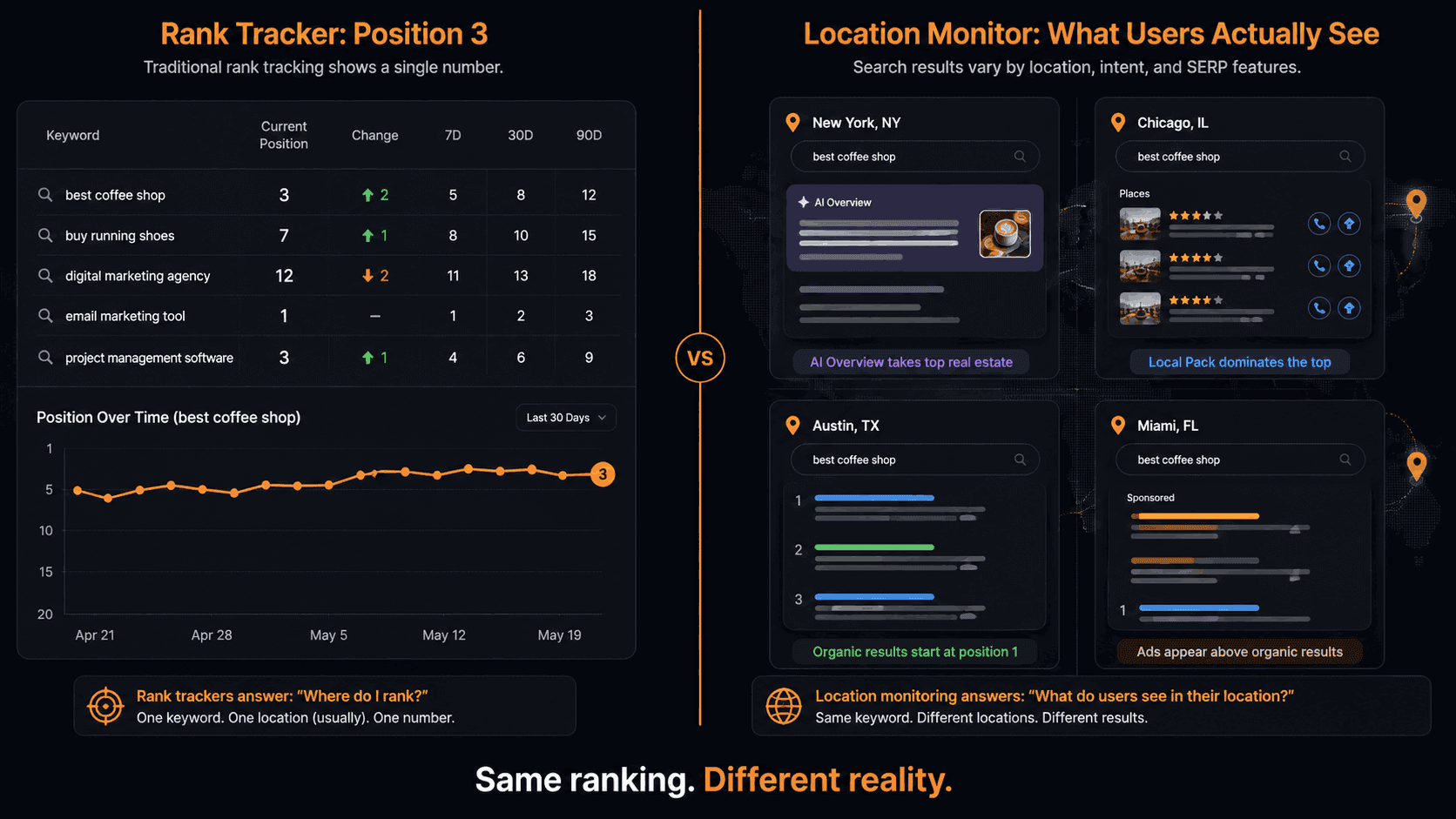
SERP Rank Tracking vs. Location Monitoring: What You're Missing
Your rank tracker is green. Your organic traffic is down. This is not a contradiction it is a measurement gap.
Rank tracking and SERP location monitoring are two different tools solving two different problems. Most SEO teams treat them as interchangeable, which is why so many miss the moments that actually move traffic.
Here is exactly what separates them and why modern search visibility requires both.
What Is SERP Rank Tracking?
Rank tracking answers one question: what numeric position does a given URL hold for a given keyword?
You configure a keyword list, point the tool at your domain, and get a daily or weekly report. Position 4 yesterday, position 3 today. The core output is a number, and that number is averaged or sampled from a single crawl location, usually a data center.
This is genuinely useful. You can detect algorithmic shifts, track recovery after a penalty, benchmark against competitors at a keyword level, and prioritize which pages need attention.
The limitation is structural. A rank tracker reports your coordinate in the search results. It does not report what the search results page actually looks like around that coordinate.
What Is SERP Location Monitoring?
SERP location monitoring watches the actual state of a search results page its layout, its features, its content and tracks when any of it changes.
Rather than asking "where do I rank," it asks: what does this page look like right now, and when did it last change?
That means tracking:
- Whether an AI Overview has appeared or disappeared
- Whether a featured snippet exists and who owns it
- Whether a local pack, video carousel, or shopping unit has been inserted
- Which URLs occupy the visible positions for a given location
- How the page layout varies across cities, regions, or countries
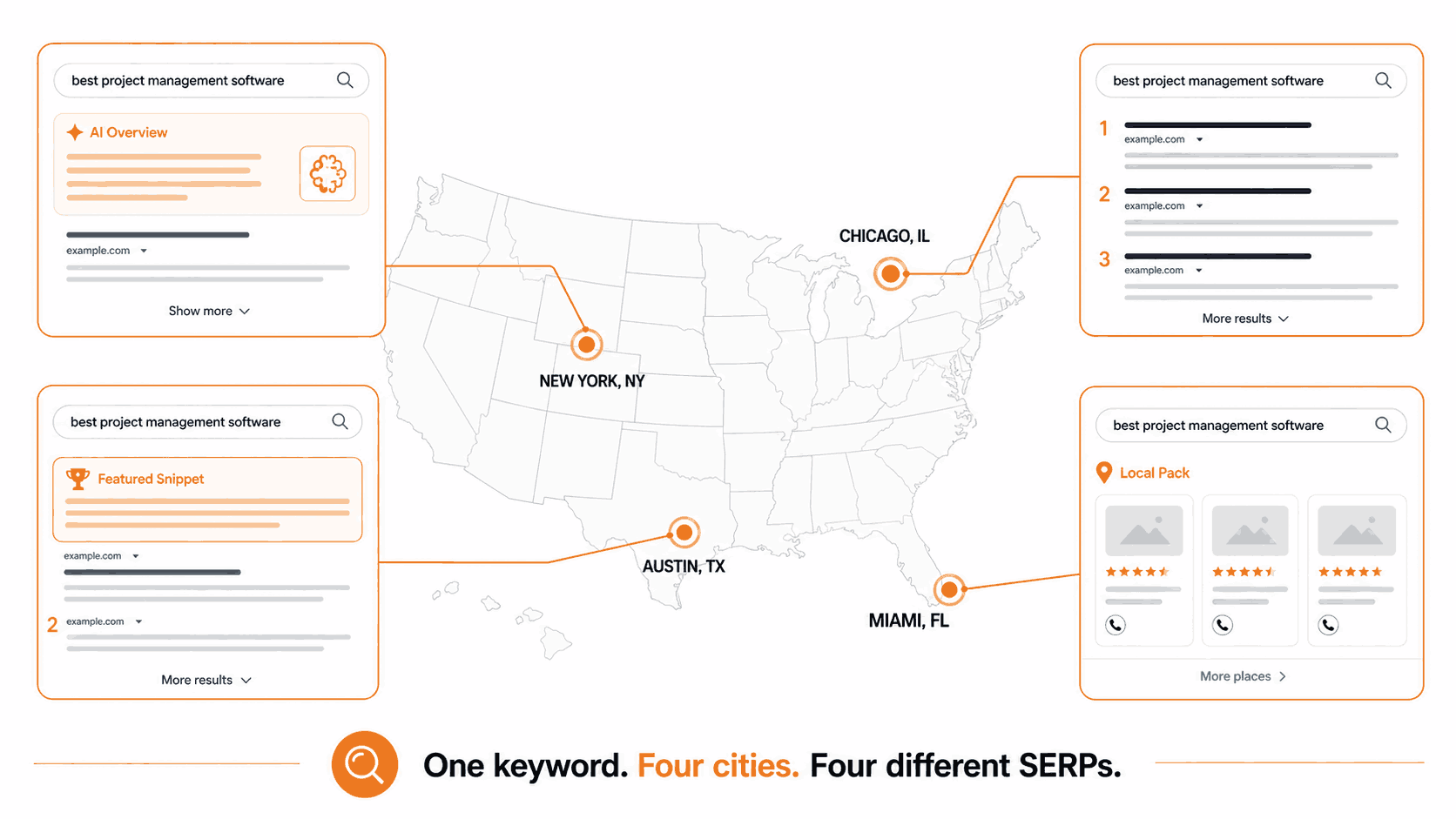
Location is central here because Google does not serve identical SERPs across geographies. A query fired from Austin may return a completely different layout than the same query from Chicago different features, different order, different organic URLs.
Key Differences
| Dimension | Rank Tracking | SERP Location Monitoring |
|---|---|---|
| Primary output | Numeric position | Full page state + field-level change log |
| Measurement unit | Keyword ranking | SERP layout, features, content |
| Location handling | Single or sampled location | Per-city or per-coordinate monitoring |
| SERP features tracked | Position only | AI Overviews, snippets, PAA, carousels |
| Alert trigger | Position change | Any page element change you define |
| Delivery | Dashboard / report | Webhook, Slack, email on change event |
| Best for | Historical trend tracking | Real-time change detection |
| Blind spots | Page layout, SERP features | Long-tail position history |
Why Rankings Alone Often Miss What Matters
Position 3 meant something different in 2019 than it does today. In 2019, position 3 was typically the third result a user saw. In 2024, position 3 may sit below an AI Overview, a featured snippet, a video carousel, and two paid ads below the fold on most screens.
Your rank tracker still reports position 3. Your click-through rate has been quietly declining for months. The two data points are both accurate. The problem is they are measuring different things.
This is not a hypothetical. Research consistently shows that SERP feature expansion has compressed the visible real estate available to organic results. Google's own search documentation acknowledges that multiple result types now compete for the same page.
A rank tracker cannot tell you when an AI Overview appeared above your result and pushed you below the fold. A position number has no concept of page layout.
Real Examples of Location-Based SERP Variation
A national SaaS company ranking third for "project management software" may have very different actual visibility depending on where a user searches:
- In San Francisco: Google surfaces an AI Overview citing three specific products. Organic listings start below it.
- In Chicago: No AI Overview. Standard organic results. Position 3 is position 3.
- In Austin: A local pack appears because Google detects commercial intent with local options.
Same keyword. Same rank. Three different user experiences and three different click probabilities.
This matters disproportionately for:
- Multi-location businesses tracking local search performance
- SaaS companies where competitors rank differently by metro
- Content teams tracking featured snippet ownership across regions
- Any team running local SEO experiments and needing quick feedback
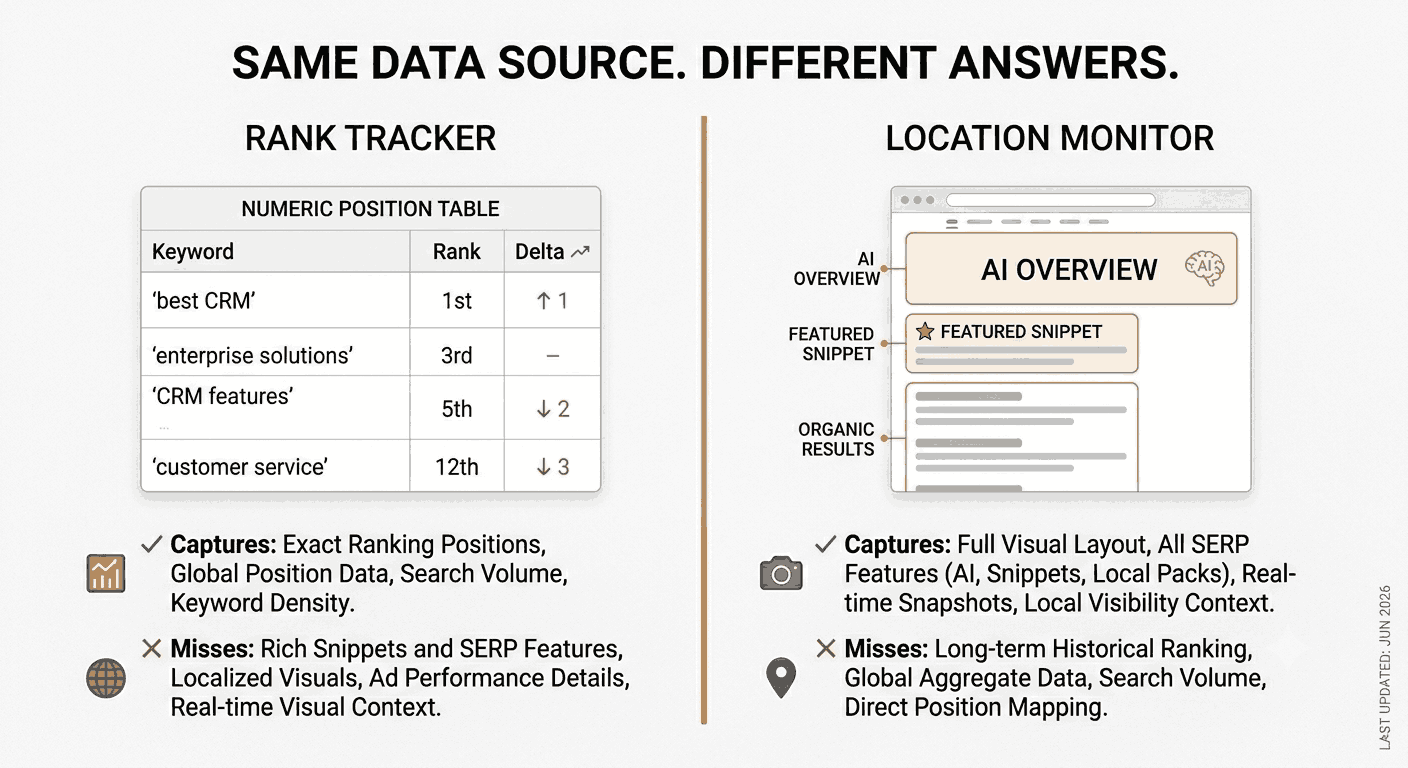
Where Traditional Rank Trackers Fall Short
Rank trackers are built around a database model: crawl, score, store, trend. That model is excellent for tracking hundreds of keywords over months.
It is poorly suited for:
SERP feature alerts. When Google inserts an AI Overview for a keyword you own, a rank tracker will not fire a notification. You find out when CTR drops in Search Console weeks later.
Layout-level visibility. A rank tracker has no concept of above-the-fold. It cannot tell you that your position 2 ranking is now visually below three non-organic units.
Localized result differences. Most rank trackers crawl from a regional data center and extrapolate. Genuine per-city SERP variation is either unavailable or very expensive to track at scale.
Competitor content changes. If a competitor rewriting the title and meta description of their position 1 page suddenly starts capturing your featured snippet, a rank tracker will not surface this unless their rank actually changes.
How Verid.dev Approaches SERP Monitoring Differently
Verid is a developer-first web change detection API that treats SERP pages the same way it treats any other URL: monitor the fields that matter, diff them on each run, and fire a webhook only when a predicate you define becomes true.
For SERP monitoring, this means pointing a monitor at a Google search URL with personalization disabled (pws=0), extracting the specific SERP elements you care about via XPath or CSS selectors, and getting a structured webhook payload the moment any of them change.
You can track:
- The title and URL of the top organic result
- Whether an AI Overview block is present
- The current featured snippet owner
- People Also Ask headings
- Your own listing's position field
Because Verid uses a real Chrome browser backed by residential proxies for rendering, the SERP it captures is what a real user in a given location would see not a data center approximation.
The predicate model is what makes this operationally clean. You do not get a notification every time Google rotates an ad. You get a notification when the field you care about changes. If you only want to know when an AI Overview appears or disappears for a keyword, you write one predicate:
{ "type": "field_changes", "field": "ai_overview" }No dashboard to check. No screenshot diffs to scroll through. A webhook hits your endpoint, your Slack channel, or your email the moment the condition is true.
Practical Use Cases
When You Need Rank Tracking
- Building a long-term keyword performance trend over 6 to 12 months
- Measuring recovery speed after a technical SEO fix
- Reporting on share of voice across a large keyword set
- Benchmarking domain authority growth against competitors
When You Need Location Monitoring
- Catching AI Overview appearances before they crater your CTR
- Alerting on featured snippet ownership changes in real time
- Validating that a local SEO change produced the expected SERP result
- Monitoring competitor content changes that affect your visible position
- Tracking SERP layout variation across cities for a national brand
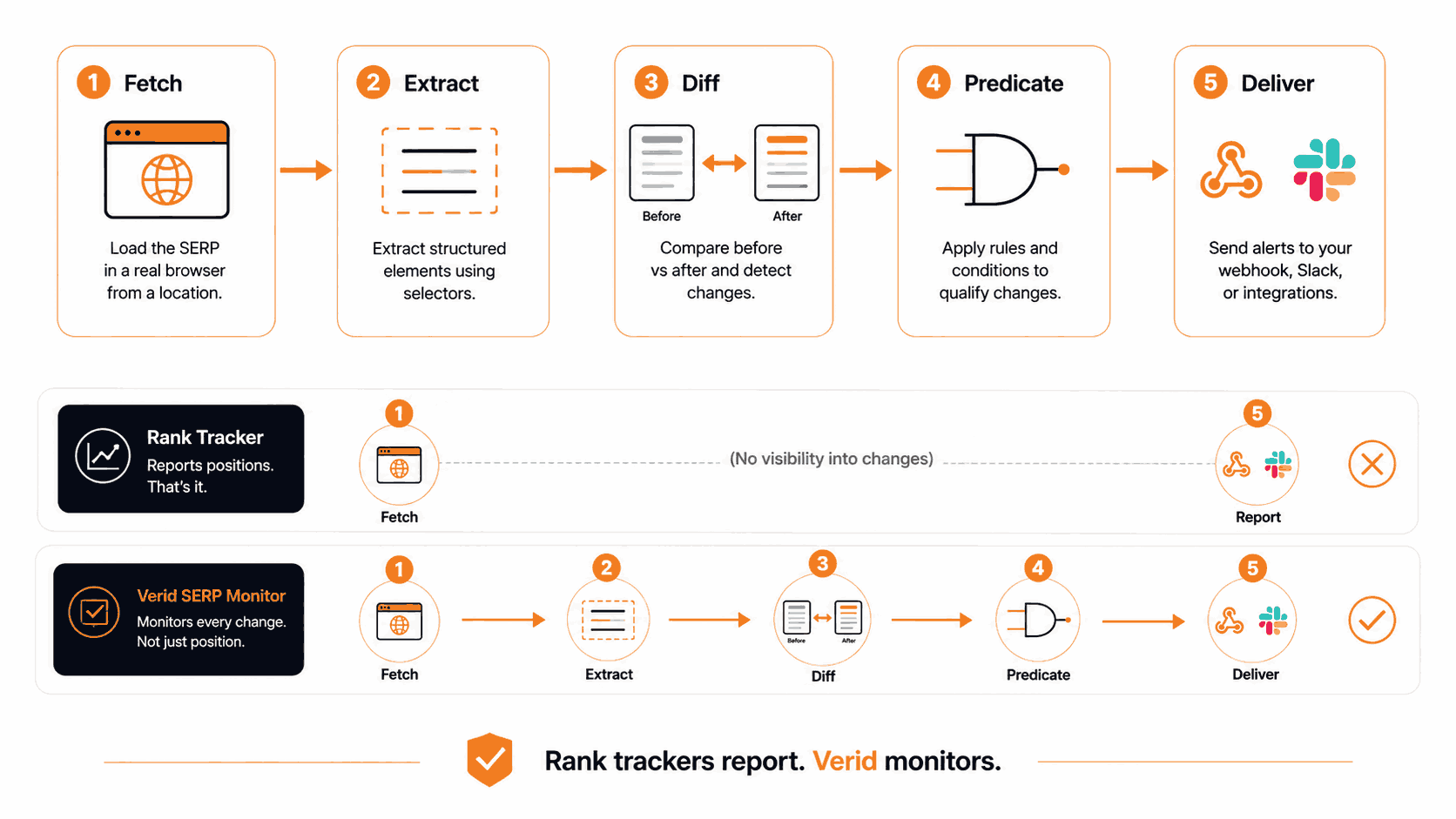
Why Modern SEO Teams Need Both
Rank tracking and SERP location monitoring are not competing tools. They answer different questions and surface different problems.
Rank tracking is the historical record. It tells you whether your SEO investments are moving your position over time. That context is irreplaceable for prioritization, reporting, and strategy.
SERP location monitoring is the real-time signal layer. It tells you when the page changed, what changed, and whether your visibility has materially shifted even when your rank has not. For fast-moving commercial SERPs where AI Overviews and feature blocks reshape the page regularly, this is not optional it is the only way to catch problems before they surface in traffic data.
The teams catching SERP shifts earliest are the ones combining both: rank trackers for strategic trends, programmatic SERP monitoring for operational alerting.
Frequently Asked Questions
What is the difference between rank tracking and SERP monitoring?
Rank tracking records the numeric position a URL holds for a keyword, sampled from a single crawl location. SERP monitoring tracks the full state of a search results page, its layout, featured elements, and content, and fires alerts when any defined field changes. Rank tracking tells you where you rank. SERP monitoring tells you what the page looks like.
Why does a page ranking position 3 sometimes get fewer clicks than position 5?
Google increasingly inserts AI Overviews, featured snippets, video carousels, and other non-organic units above organic results. A position 3 listing may sit below several of these units and appear below the fold on mobile. Rank trackers report the coordinate. They do not report whether the coordinate is visible.
How do search results differ by location?
Google personalizes results based on the user's geographic location. The same keyword searched from New York and from Austin may return different featured snippets, different local packs, different AI Overview content, and different organic URLs. A national rank tracker samples from a representative location and may miss material variation at the city level.
Can Verid.dev monitor specific SERP fields for location-based queries?
Yes. You create a monitor pointing at a Google search URL with a specific location parameter (gl=us, near=cityname, or coordinate-level targeting), configure XPath or CSS selectors for the SERP elements you want to track, and set a predicate to fire when any of those fields change. Verid renders the page with a real browser, extracts the fields, and delivers a structured webhook payload on each change. See the SERP monitoring use case for implementation details and code examples.
About the author

Software Engineer & Technical Writer
Hanzala is a software engineer and technical writer covering web monitoring, automation and API design. He builds the integrations he documents, which is why the code samples in his posts tend to work on the first try.
More from HANZALA SALEEM →Related posts
What SERP analysis actually covers in 2026
SERP analysis tools compared: rank trackers, change detection, AI Overview support, pricing, and features — find the right fit for 2026.
Read the post →serp monitoringHow to Track SERP Location Changes: An Automated Monitoring Guide
Learn why Google rankings differ by location and how to monitor SERP location changes automatically using Verid's change detection API.
Read the post →change detectionFree Website Change Monitors Compared (No Card Required)
Compare free website change monitors that need no credit card. Real limits, check frequency, and which tool actually fits your use case.
Read the post →visual monitoringVisual Regression Testing vs Visual Monitoring: Which Do You Need?
Visual regression testing catches bugs before release. Visual monitoring catches changes after deployment. Learn the difference and which one you need.
Read the post →