Visualping Alternative? Verid vs Visualping Compared
If you are evaluating Visualping and looking for a direct comparison, this post lays out what each tool actually does, where each one pulls ahead, and which use cases each one is built for. No sales spin - just an honest look at two different approaches to website change monitoring.
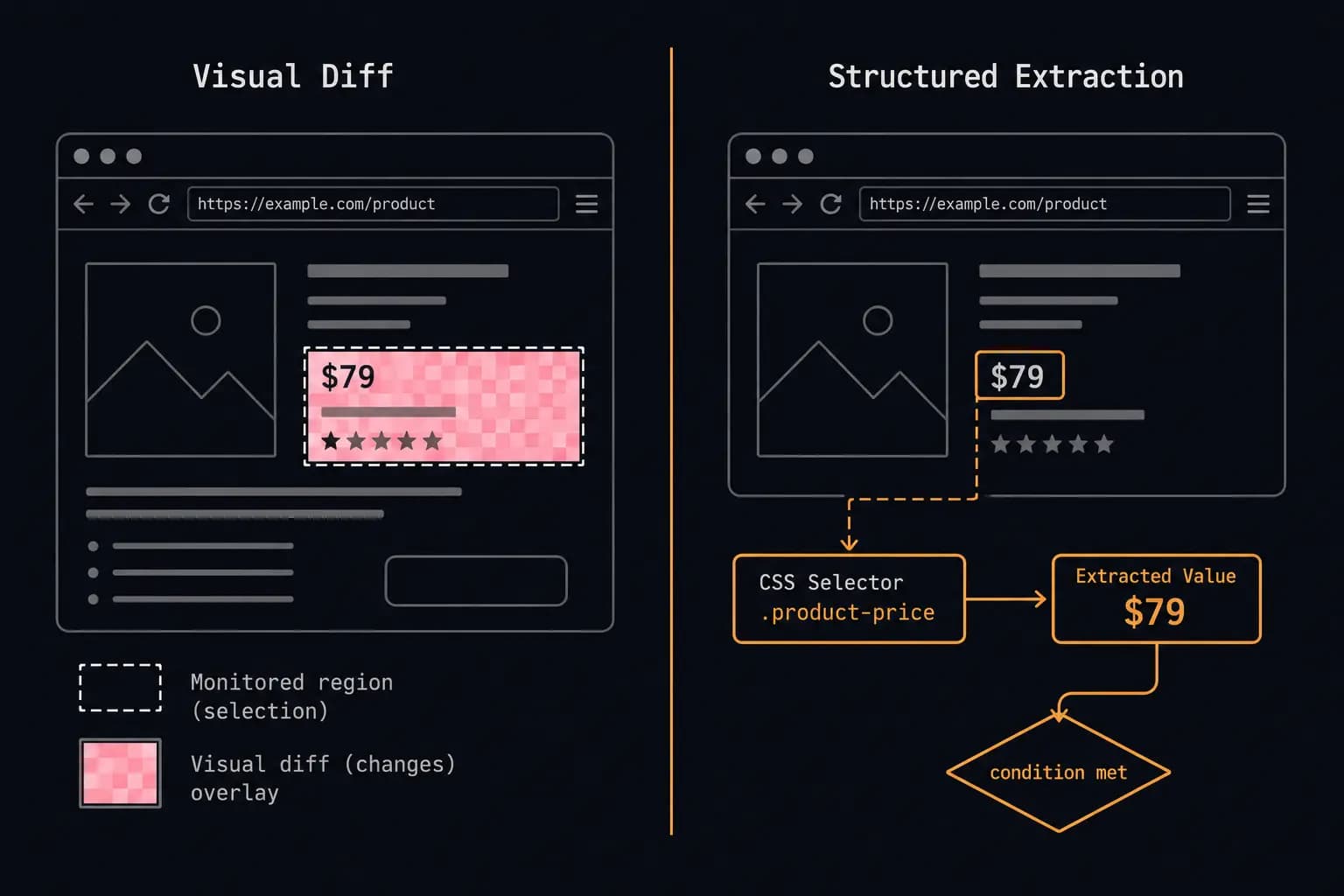
The short version: Visualping is a visual diffing tool. It takes screenshots of a page and highlights what changed in the rendered image. Verid is a structured data extraction tool first - it monitors specific fields on a page using CSS or XPath selectors, evaluates conditions before firing alerts, and delivers results to Slack, Discord, email, or a signed webhook - and it now includes visual monitoring as its own monitor type: a drag-to-select, threshold-gated screenshot diff. So the real difference is not "visual vs. data" anymore; it is whether you want the visual diff alone, or the visual diff plus the data layer alongside it.
If you already know you want structured extraction, predicate-based alerting, or webhook delivery for a website change monitoring use case, jump straight to the comparison table. If you are still weighing approaches, read through - the distinction matters more than it might seem.
What Visualping Does
Visualping built its reputation on one core idea: capture a visual snapshot of a webpage and alert you when the pixels change. You point it at a URL, draw a selection rectangle around the area you care about, and it emails you when that region looks different from the last check.
The browser extension is the most frictionless part of the product. You visit any page, click the extension icon, drag to select a region, and you are monitoring. There is no configuration beyond the area selection and the alert email. This is genuinely good product design for the use case it targets: non-technical users who want to know when a job posting disappears, when a product goes on sale, or when a competitor's hero image changes.
Visualping also has a web app with multi-page campaigns, team sharing, and various check frequency tiers. The visual diffing core runs across all of it.
What visual diffing does not do well: it cannot tell you what the underlying value is, only that the pixels changed. If a price dropped from $99 to $79, Visualping tells you the page looks different. It cannot tell you the new price was $79, whether that drop exceeds 10%, or whether a downstream system should trigger a reorder workflow. That gap is where the tools diverge.
What Verid Does
Verid approaches the same problem from the data layer. Instead of comparing screenshots, it extracts specific fields from a page using CSS selectors or XPath expressions, stores the extracted values over time, and fires alerts when those values change in ways you define.
The monitoring setup looks different too. On Verid's features page, each monitor has three configuration layers:
- Extraction - a CSS selector or XPath targeting the specific element(s) you care about, with a type annotation (text, number, attribute value)
- Schedule - how often to check (as often as every minute on every plan and during the free trial; each check uses one run from your allowance)
- Alerting - an optional predicate that controls when a change actually triggers a delivery
The predicate layer is the key differentiator. Rather than firing on every pixel change, Verid lets you set conditions: alert only when the price drops by more than 10%, only when a field matches a regex, only when a numeric threshold is crossed. This is explained in more depth in the post on predicate-based alerting. The practical effect is that you stop getting woken up by footer timestamps and CDN cache comments, and you only get an alert when something you actually care about happened.
Verid also ships HMAC-SHA256 signed webhooks via the Verid-Signature header, which means you can pipe change events directly into a workflow, a database, or a Slack channel with verification that the payload came from Verid and was not tampered with. There is a REST API and an npm SDK for teams managing monitors programmatically.
Verid also has visual monitors: a screenshot is captured on every check and compared pixel by pixel against the previous one. You drag a box over the part of the page you care about, mask out noisy elements like ad slots and timestamps, and set a change threshold (1%, 5%, 10%, or custom) so sub-threshold churn never fires an alert. Alerts include the before, after, and red-highlight diff images. Run a visual monitor next to a structured one on the same URL and you get both signals.
Head-to-Head Comparison
| Feature | Visualping | Verid |
|---|---|---|
| Detection method | Visual screenshot diff | Structured field extraction (CSS/XPath) + visual screenshot diff |
| Setup method | Browser extension or web app | Web dashboard or API |
| Technical skill required | Minimal | Low-moderate (selector writing) |
| Extracted data value | No - pixel diff only | Yes - stores field values over time |
| Visual screenshot diff | Yes - core feature | Yes - drag-to-select region, threshold-gated |
| Conditional alerting | No - alerts on any visual change | Yes - predicate logic (threshold, regex, equality) plus a pixel-change threshold for visual checks |
| Webhook delivery | Limited | Signed HMAC-SHA256 webhooks |
| Slack/Discord delivery | Yes (paid tiers) | Yes |
| Email alerts | Yes | Yes |
| REST API | Limited | Full REST API with vrd_ key auth |
| JavaScript-rendered pages | Yes | Yes (browser mode) |
| Free plan | Yes (limited checks) | No - 14-day free trial, no card (unlimited monitors, 200 runs) |
| Primary audience | Non-technical users, marketers | Developers, data teams, ops engineers |
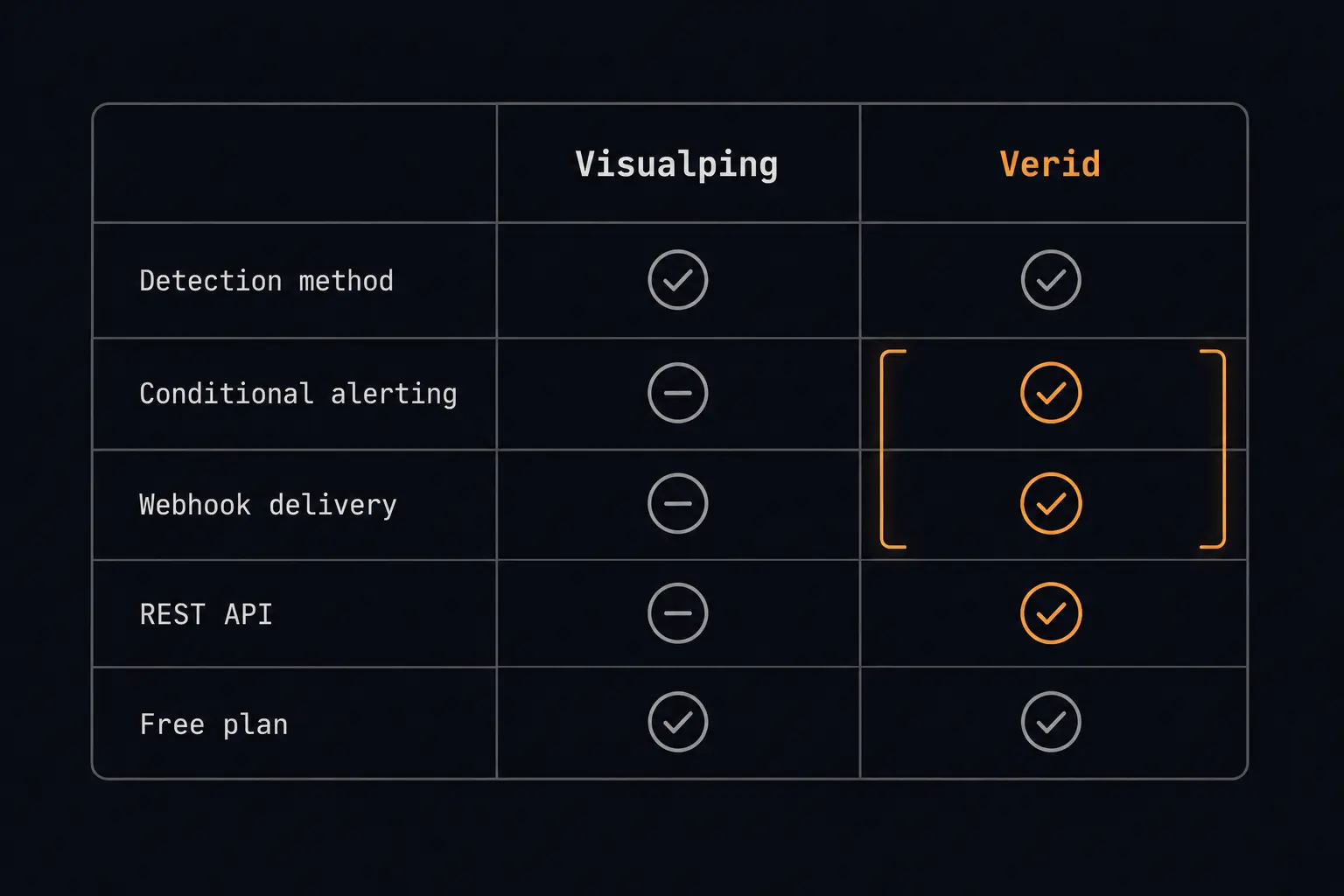
The table makes it clear these are tools with different ceilings. Visualping's ceiling is the visual diff itself - when you need to do something with the change value, you hit a wall. Verid's ceiling is integration depth - when you need a webhook receiver, predicate logic, and programmatic monitor management, that is what the tool is built for.
Where Visualping Wins
Visualping is genuinely better in a few situations and it is worth being direct about them.
Zero technical setup. If you need to monitor a page right now and do not want to write a CSS selector or configure a webhook, the Visualping browser extension is faster to get started with than any structured-extraction tool. Click, drag, done.
A more mature visual workflow. Visual diffing is Visualping's entire product, and it shows: the drag-to-select flow in the extension, AI-generated change summaries on every plan, and years of polish on the email digest. Verid's visual monitors cover the same primitive (drag-to-select region, pixel comparison, change threshold), but Visualping's surrounding workflow for purely visual, email-first monitoring is more built out today.
Non-technical teams. Marketers, journalists, and researchers who watch pages for content changes and need an email summary of "here is what changed" will find Visualping's interface more accessible. Selector writing is a minor but real friction point.
Where Verid Wins
The gap grows the moment you need to act on a change rather than just observe it.
Structured data extraction. Verid extracts field values - the actual price, the actual stock count, the actual version string - not a pixel diff. Over time you build a history of values, not just a history of change events. You can query what the price was three weeks ago.
Predicate-based alerting. This is the biggest operational difference. On Visualping, every detected change fires an alert. On Verid, you decide what conditions turn a change into an alert. A 2% price fluctuation in a currency display string does not wake you up. A 15% price cut does. For high-frequency monitors, this difference eliminates alert fatigue almost entirely. The post on stopping monitoring spam with predicates covers the full predicate type reference.
Webhook integration. If you want change events to flow into a downstream system - a Slack bot, a database write, a restock notification email to customers - you need a signed webhook. Verid ships Verid-Signature HMAC-SHA256 on every delivery. You verify the signature in your receiver and trust the payload. This is the same pattern major payment processors use for event delivery.
Developer workflow. Managing 50 monitors via a browser extension does not scale. Verid has a REST API and an SDK so you can create, update, and delete monitors from CI pipelines, scripts, or internal dashboards. See the Verid features overview for the full API surface.
Competitor intelligence at scale. If you are tracking pricing, availability, or content changes across dozens of competitor pages, structured extraction with predicates reduces noise dramatically. The Google Alerts alternatives post maps this landscape across several tools for context.
Pricing Philosophy
Visualping has a free tier that limits the number of pages you can monitor and the check frequency. Verid offers a 14-day free trial instead: unlimited monitors, 200 runs for the whole trial, checks as often as every minute, and 14-day history, no credit card required. On the paid side, Verid's pricing page starts at $9/month (Lite: 1,000 runs a month) and scales to $149/month (Scale: 100,000 runs a month), with unlimited monitors on every plan.
The 14-day free trial is intended to let you evaluate the product on real monitors before committing. When it ends, your monitors pause (nothing is deleted) until you choose a plan.
For a broader comparison of website monitoring tools across different categories, the changedetection.io vs Verid post covers another open-source alternative worth considering.
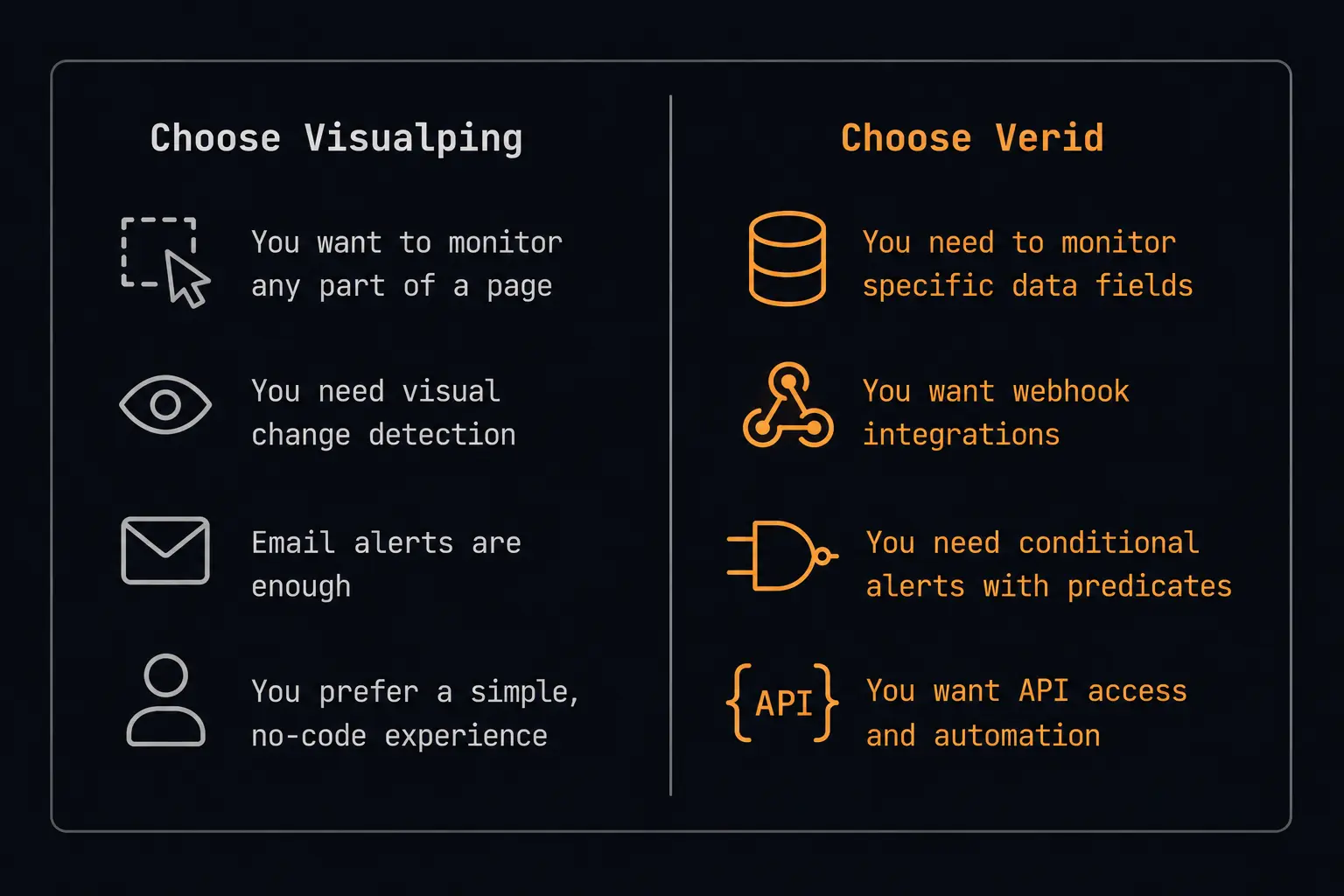
Choose Visualping If...
- You want to start monitoring a page in under 60 seconds with no configuration
- You want an email-first, purely visual workflow with AI change summaries and nothing else
- You do not need to act programmatically on change events
- Your team is non-technical and needs an approachable email-based workflow
- You want to check whether a specific section of a page looks different, without caring what the underlying values are
Choose Verid If...
- You need to know the actual value that changed, not just that something changed
- You want to suppress noise with conditional alerting - only alert when price drops by a threshold, a regex matches, or a field equals a specific value
- You need signed webhook delivery to a downstream system
- You manage monitors programmatically via API or SDK
- You are tracking 10+ pages and alert fatigue is already a problem
- Your use case is developer or data-team oriented: competitor intelligence, pricing surveillance, job listing tracking, release monitoring
How to Get Started with Verid
Setting up your first monitor takes under five minutes.
- Start a 14-day free trial at verid.dev - no credit card required
- Create a monitor by entering the URL you want to watch
- Use your browser's DevTools (right-click, Inspect) to find the CSS selector for the element you care about - the guide on finding CSS selectors and XPath expressions walks through this step-by-step
- Set a schedule (as often as every minute on any plan, trial included; each check uses one run)
- Optionally add a predicate on the Alerting tab to filter out noise
- Add a Slack webhook, Discord webhook, email, or signed HMAC webhook as your delivery endpoint
Your first alert will arrive on the next scheduled check after Verid detects a change that satisfies the predicate. The full list of Verid features and pricing tiers are on the site if you want to compare plans before signing up.
Frequently Asked Questions
Is Verid a direct Visualping replacement?
Closer than it used to be. Visualping is visual-first; Verid is extraction-first but now includes drag-to-select visual screenshot diffing as its own monitor type, so the visual use case is covered. If you are currently using Visualping for its browser extension convenience, Verid requires slightly more setup. If you were using Visualping because you needed webhook delivery, conditional alerting, or field-level data and found it limiting, Verid is the more direct fit - and you keep the visual diff.
Does Verid do visual screenshot diffs like Visualping?
Yes. Create a visual monitor, drag a box over the part of the page you care about, and Verid screenshots it on every check, compares it pixel by pixel against the previous one, and alerts when the changed area passes your threshold. Noisy elements like ads and timestamps can be excluded, and alerts include the before, after, and highlighted diff images.
Does Verid have a browser extension like Visualping?
Not currently. Verid monitors are created from the web dashboard or via the API. You specify the URL and the CSS selector for the element you want to extract. The tradeoff is that setup takes slightly more than a drag-and-drop - but you also get a richer result (the extracted value, not just a pixel diff) and conditional alerting on top of it.
Can Verid monitor JavaScript-rendered pages the way Visualping does?
Yes. Verid has a browser mode that renders the full page with a headless browser before extracting, so single-page applications and dynamically loaded content work the same as static HTML pages.
How does predicate-based alerting compare to Visualping's change sensitivity settings?
Visualping has sensitivity sliders that control how much visual change triggers an alert. Verid predicates operate on the extracted data value itself. Rather than "alert on 10% pixel change," you can write "alert only when the numeric price field drops by more than 5" or "alert only when the text field matches a regex." This is more precise because it operates on the data, not the rendering.
Does Verid support team sharing like Visualping?
Not currently. Each Verid account belongs to one user; to keep a team in the loop, send alerts to a shared Slack or Discord channel, an email address, or a webhook. See the pricing page for the per-plan breakdown.
What delivery channels does Verid support?
Verid delivers alerts to Slack (incoming webhooks), Discord (webhooks), email, and signed HMAC-SHA256 webhooks for custom integrations. The webhook payload includes the before/after field values, the monitor ID, and a signature header you can verify in your receiver.
Is Verid free to start?
Yes, for 14 days. Every new account gets a 14-day free trial with unlimited monitors, 200 runs, and 14-day history. No credit card required. When the trial ends, monitors pause until you choose a plan; paid plans start at $9/month for 1,000 runs.
What happens if I need more runs?
Upgrade to Lite ($9/month) for 1,000 runs a month or Starter ($19/month) for 5,000, or buy run credits that never expire. Monitors are unlimited on every plan. The Verid pricing page has the full tier comparison.
About the author

Software Engineer
A software engineer who works on distributed job processing and web scraping, Suleman helps run the pipeline that powers Verid’s monitors. He writes about extracting data from pages that weren’t built to be extracted from.
More from Suleman →Related posts
Free Website Change Monitors Compared (No Card Required)
Compare free website change monitors that need no credit card. Real limits, check frequency, and which tool actually fits your use case.
Read the post →comparisonApify Alternative for Scheduled Website Monitoring
Compare Apify Actors to a dedicated change monitoring API. See when building an Actor makes sense, and when webhooks on a rule get you there faster.
Read the post →comparisonFirecrawl vs Verid: A Scraping API and a Monitoring Loop Are Not the Same Thing
Firecrawl scrapes and now checks pages on a schedule. Verid is built only for monitoring. Here's the real architectural difference.
Read the post →competitor monitoringHow to Track When a Competitor Switches Their Tech Stack (Without Checking Manually Every Week)
Stop manually re-checking BuiltWith. Learn how to get alerted the moment a competitor's site changes its tech stack, with a real workflow.
Read the post →