Best Competitor Pricing Tools in 2026: Compared for Developers and Growth Teams
Pick the wrong competitor pricing tool and you end up with one of two problems. Either you're staring at a polished retail dashboard that cannot talk to your stack, or you're gluing together a scraper, a scheduler, and a Slack webhook and calling it a "system."
In 2026 there are real options across that spectrum. This post compares eight competitor pricing tools side by side so you can choose based on what your pipeline actually needs, not what a vendor's marketing page says. The comparison covers both audiences in the post's title: developers who need an API-native, webhook-first competitor price monitoring software they can build into their product, and growth teams who need dashboards, alerts, and fast time-to-value without writing code.
Here is what each tool does well, where it falls short, and which audience it genuinely serves.
One scoping note up front. If you are a pure ecommerce operator whose only job is tracking retail product prices across a SKU catalog and enforcing MAP, this is not the post you want; read Best Price Monitoring Tools for Ecommerce instead, which compares the same category through a retail-catalog lens. This post is written for the two audiences who fall outside that frame: developers wiring competitor price data into a pipeline or product, and growth teams running competitive intelligence across pages that are not retail PDPs.
The Comparison Table
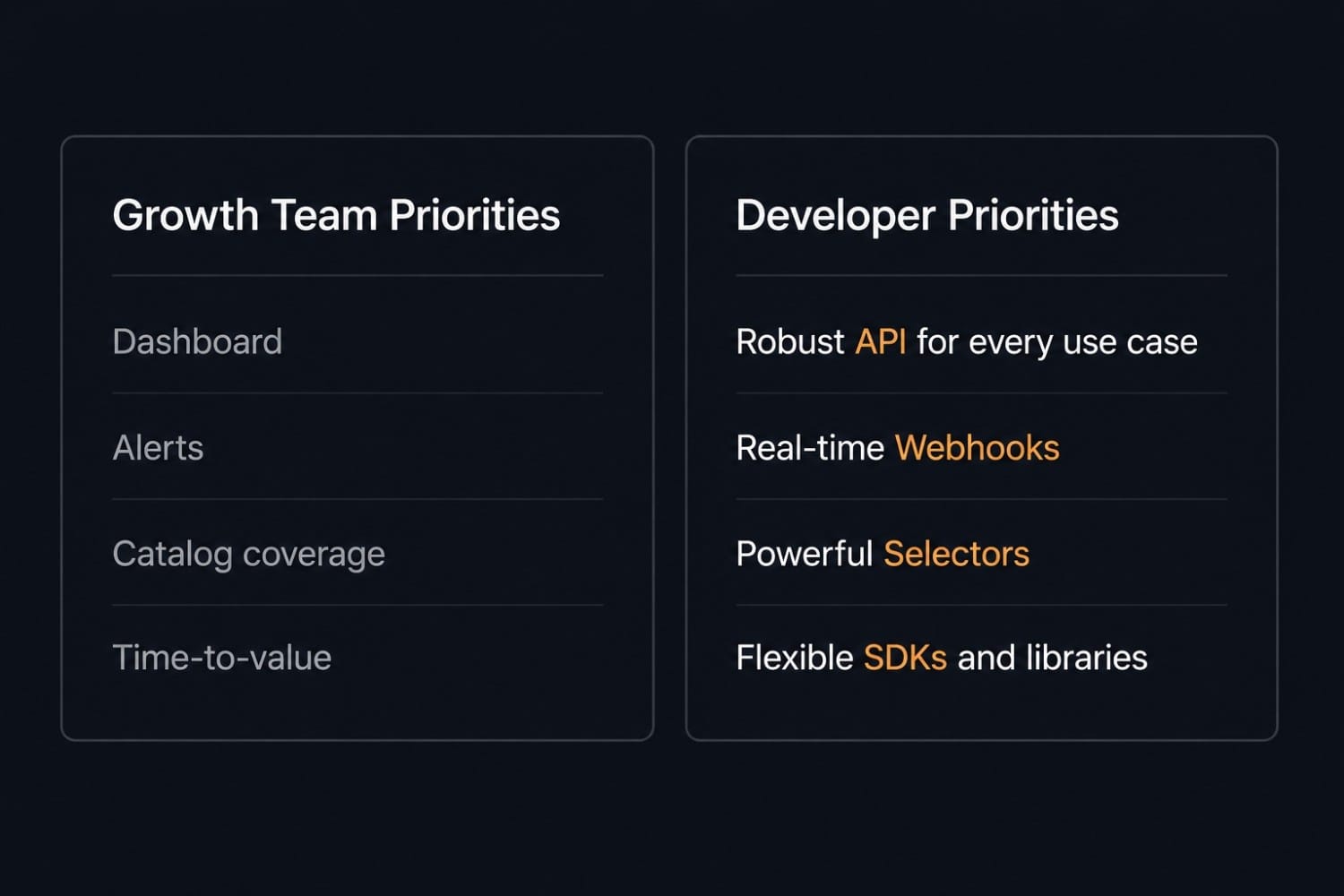
The columns that matter most differ by audience. Developers care about API access, webhook reliability, selector-level extraction, and how the tool fits into an existing stack. Growth teams care about setup time, dashboard quality, alert channels, and whether the pricing makes sense for their catalog size.
| Tool | Category | Setup approach | API / webhook access | Pricing model | Ideal user |
|---|---|---|---|---|---|
| Verid | Web change detection | API key + URL + CSS/JSON selector | REST API (OpenAPI 3.1), HMAC-signed webhooks, Node.js SDK, dead-letter queue | 14-day free trial, no card / $9-$149/mo | Developer or builder embedding monitoring into a product or pipeline |
| Prisync | Retail price monitoring | Connect catalog via CSV/integration, rule-based repricing alerts | API available on higher plans; webhook support limited | $99-$399/mo (by SKU volume) | Ecommerce manager tracking catalog pricing against direct competitors |
| Price2Spy | Retail price monitoring | Add competitors via URL upload or browser plugin | API on Enterprise; webhook delivery available | $9.95-$400+/mo (by tracked product count) | Mid-market ecommerce team needing MAP compliance and price history |
| Competera | Pricing optimization platform | Onboarding session + catalog integration | API for data export; no self-serve API provisioning | Custom enterprise pricing | Enterprise pricing team wanting AI-driven repricing recommendations |
| Intelligence Node | Price intelligence / data feed | Enterprise onboarding + data feed setup | Data feed via SFTP/API; developer integration requires contract | Custom enterprise pricing | Retailer or brand needing large-scale catalog intelligence |
| Wiser | Omnichannel price intelligence | Catalog upload + managed setup | API and webhooks available; not self-serve | Custom pricing | Mid-market and enterprise ecommerce with MAP enforcement needs |
| Browse AI | No-code web scraping | Visual point-and-click robot builder | Webhook delivery; limited structured API | Free (limited) / $19-$249/mo | Non-technical user who needs to scrape any page without code |
| changedetection.io | Open-source change detection | Self-host (Docker) or $8.99/mo cloud | Basic REST API; webhooks via Apprise (no HMAC signing, no retries) | Free self-hosted / $8.99/mo cloud | Developer or power user who wants full data control and is happy to self-host |
A few things the table cannot convey fully: Verid is the only tool here where the API is the primary interface rather than an afterthought. Every other tool in this list was designed for a dashboard-first workflow, with API access bolted on later or gated behind a higher tier. That distinction matters if you are embedding competitor price tracking software into your own product rather than using it standalone.
Prisync: Strong for ecommerce catalog management
Prisync is purpose-built for online retailers tracking prices across direct competitors. You import your product catalog, map competitor URLs to your SKUs, and Prisync tracks the price deltas at regular intervals. The dashboard shows your price position relative to competitors and fires alerts when a threshold is crossed.
The repricing rule engine is genuinely useful for teams running dynamic pricing. You define rules like "keep my price 5% below Competitor A, but never below $X" and Prisync manages the execution.
What Prisync is not: a general-purpose price intelligence tool for pages that are not retail product listings. If you want to monitor a competitor's pricing page copy, a SaaS tier change, or a job listing, it is not the right tool. The API is available on higher plans but is not a first-class surface designed for programmatic workflows.
Good fit: Ecommerce manager running a 500-SKU catalog who needs daily price position tracking against 3-5 named retailers.
Price2Spy: Deep MAP compliance and price history
Price2Spy has been in this category since 2010 and has the product depth to show for it. The standout feature for manufacturer or brand teams is MAP (minimum advertised price) compliance reporting. Price2Spy tracks whether your resellers are honoring MAP and generates reports you can take to a channel manager.
The tool supports browser-based fetching for JavaScript-rendered pages and handles dynamic pricing environments reasonably well. Price history goes back as far as the monitoring period covers, which matters for seasonal trend analysis.
The ceiling is the same as Prisync: it is a retail-focused competitor price monitoring software built around SKUs and product catalogs. Non-retail use cases (SaaS competitor monitoring, landing page changes, API endpoint monitoring) are outside its scope, and there is no self-serve, API-first surface a developer would build against. If MAP enforcement and catalog depth are your priority rather than developer ergonomics, our ecommerce price monitoring comparison and the MAP pricing compliance use case go deeper on that angle.
Good fit: Brand or distributor team needing MAP compliance documentation and a long price history for seasonal analysis. Less of a fit if your output has to feed code.
Competera: AI-driven pricing for enterprise
Competera sits above the other tools here on ambition and price. It is not just a monitoring platform. It is a pricing optimization product that uses machine learning to recommend optimal prices based on competitor data, demand elasticity, and margin constraints.
If your pricing decisions are currently made in a spreadsheet with a handful of analysts, Competera replaces that workflow with a model-driven recommendation engine. The value proposition is real, but the complexity and cost reflect it. Onboarding is a multi-week process. There is no self-serve pricing on the website.
For teams that want to "plug in an API and get competitor price data," Competera is the wrong layer in the stack.
Good fit: Enterprise pricing team at a large retailer with hundreds of thousands of SKUs and dedicated analysts who can act on model recommendations.
Intelligence Node: Large-scale retail data feeds
Intelligence Node operates more as a data provider than a monitoring tool. The primary output is a data feed of competitor prices across a large retailer catalog, delivered via SFTP or API. This suits enterprise brands that need pricing intelligence at scale but want to consume it as a data layer inside their own BI stack rather than through a vendor dashboard.
The trade-off is that everything is contract-based and managed. You are not setting up monitors yourself. Intelligence Node's team crawls the targets and delivers the data.
Good fit: Retailer or brand with a data engineering team and a six-figure data budget that wants market-wide pricing intelligence as a raw feed.
Wiser: Omnichannel with MAP enforcement
Wiser covers retail price tracking across online and in-store channels, which makes it unusual in this list. The omnichannel angle is the differentiator: if you need to track prices at physical retailers as well as online marketplaces, Wiser has the crawling and data collection infrastructure to do it.
The API and webhook support exist but are not self-serve on standard plans. Wiser's sales team qualifies leads before providing API credentials, which means the tool is not an option for a developer who wants to start with a free tier and build up.
Good fit: Consumer goods brand with physical retail distribution that needs both online and brick-and-mortar price intelligence.
Browse AI: No-code scraping for non-technical users
Browse AI is not a competitor pricing platform in the traditional sense. It is a visual robot builder that lets you point and click at any page and define what data to extract, then schedule that extraction to run on a recurring basis. You can extract price data this way, but you are building a one-off scraper, not configuring a structured monitoring system.
The appeal is obvious for non-technical users: you do not need to write CSS selectors or understand HTTP headers. The tool takes screenshots of the page and lets you click on the elements you want.
The limitations for developer use cases: no predicate alerting, webhook payloads carry raw extracted text rather than typed structured data, and the robot approach breaks when a competitor's page layout changes. There is no equivalent of Verid's structured diff output or predicate conditions like "only alert if price drops more than 10%."
For a growth team that needs to pull competitor pricing data into a Google Sheet on a weekly basis, Browse AI is a reasonable choice. For a developer building a repricing pipeline or a compliance system, the lack of API-first design and structured output creates downstream parsing work.
Good fit: Operations or growth team member with no coding background who needs to export data from competitor pages into a spreadsheet.
changedetection.io: Open-source, self-hosted, and honest about its scope
changedetection.io is the most credible open-source tool in this space and worth taking seriously. 25,000+ GitHub stars, a Docker-first deployment model, and $8.99/month for 5,000 cloud watches. If you want data sovereignty and do not mind running infrastructure, it is hard to beat on cost.
The limitations are architectural. changedetection.io diffs text regions, not structured data fields. When a price changes from $49 to $39, you get a text diff. You do not get a typed payload with previous_value: 49.00, current_value: 39.00, and change_percent: -20.4. The consumer of that webhook has to parse the text.
There is also no field-level predicate alerting. The tool fires when anything in the watched region changes. You cannot write a rule that says "only alert if the price drops by more than 5%." Webhook delivery via Apprise is fire-and-forget: no HMAC signing, no retry logic, no dead-letter queue.
For a full breakdown of this comparison, the changedetection.io vs Verid post covers the architectural gaps in detail.
Good fit: Developer or homelab user who wants self-hosted change detection and is comfortable building the structured-output and retry logic in their own consumer code.
Verid: Competitor pricing tools for developers and builders
Verid is the only tool in this list where the API is the primary interface. Every feature available in the dashboard is also available via the REST API (OpenAPI 3.1 spec) and the official Node.js SDK. Monitors can be provisioned programmatically, checked on demand, and queried for diff history without opening a browser.
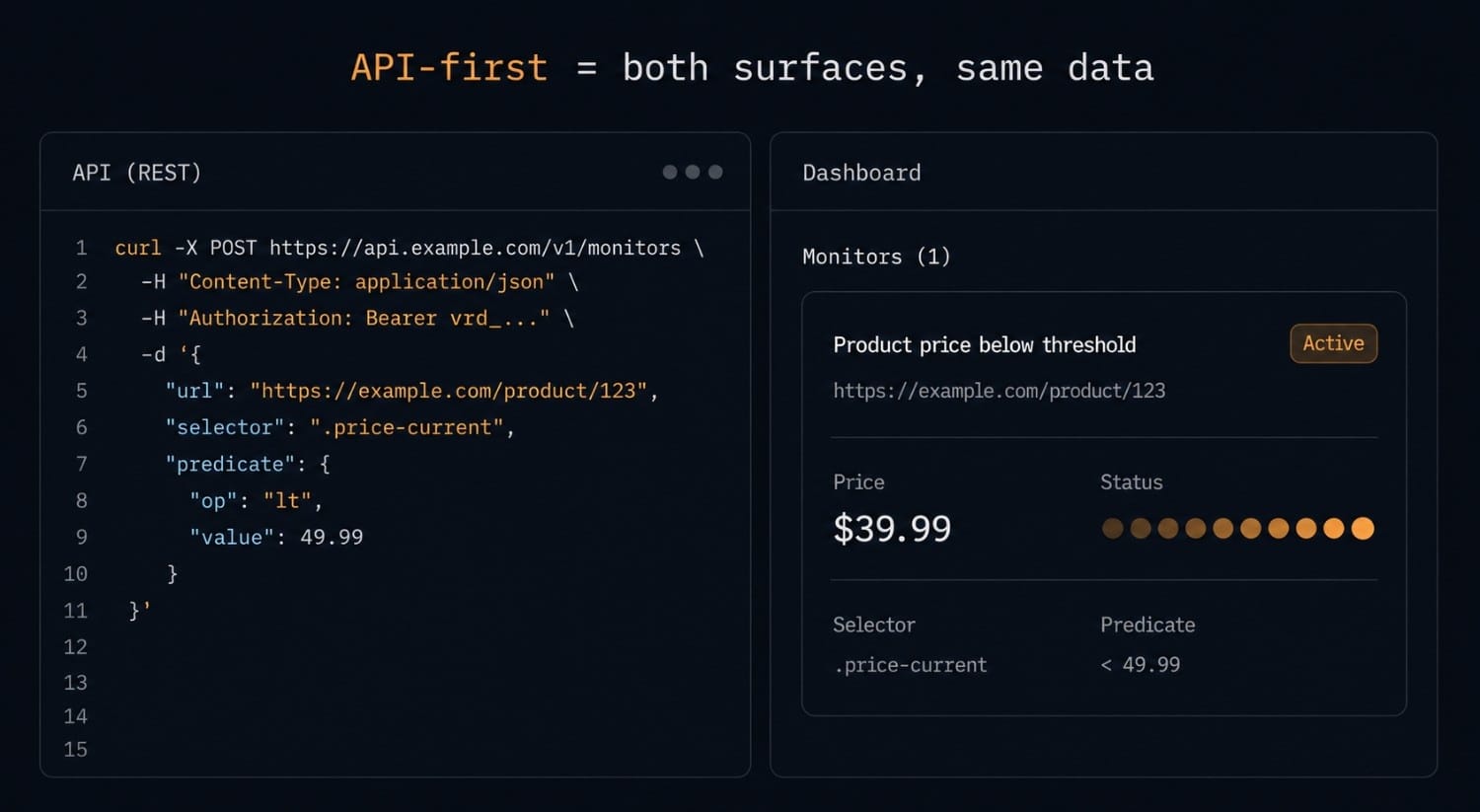
Because the API is the product, provisioning a competitor price monitor is a single call. Create one with the REST API and a CSS selector plus a predicate, and the webhook fires only on a real price drop:
curl -X POST https://api.verid.dev/api/v1/monitors \
  -H "Authorization: Bearer vrd_live_..." \
  -H "Content-Type: application/json" \
  -d '{
    "url": "https://competitor.example/pricing",
    "selector": ".plan-pro .price",
    "extract": "number",
    "interval": "5m",
    "predicate": { "field_decreases_by_percent": 5 },
    "webhook_url": "https://hooks.your-app.example/price"
  }'
The change event your endpoint receives is typed, not a text diff you have to parse:
{
  "event": "monitor.changed",
  "monitor_id": "mon_8f2c…",
  "field": "price",
  "previous_value": 49.00,
  "current_value": 39.00,
  "change_percent": -20.4,
  "detected_at": "2026-06-10T14:03:11Z"
}
The same thing in TypeScript via the official SDK, with the HMAC signature verified before you trust the payload:
import { Verid, verifySignature } from "@verid/sdk";

const verid = new Verid({ apiKey: process.env.VERID_API_KEY });

await verid.monitors.create({
  url: "https://competitor.example/pricing",
  selector: ".plan-pro .price",
  extract: "number",
  interval: "5m",
  predicate: { field_decreases_by_percent: 5 },
  webhookUrl: "https://hooks.your-app.example/price",
});

// in your webhook handler
app.post("/price", (req, res) => {
  if (!verifySignature(req.rawBody, req.header("Verid-Signature"), secret)) {
    return res.status(401).end();
  }
  const { previous_value, current_value, change_percent } = req.body;
  // react: reprice, alert Slack, write to the warehouse
  res.status(200).end();
});
No other tool in this comparison treats monitor creation and structured change delivery as first-class API calls like this. The full surface is documented at the API reference and the REST API feature page.
The key differences from the other tools in this list:
Any page, not just retail PDPs. The other dedicated price monitoring tools are built around the assumption that you are monitoring product detail pages on an ecommerce site. Verid monitors any URL: a SaaS competitor's pricing page, a JSON API endpoint, a government tender posting, a job listing. The extraction layer uses CSS selectors, XPath, JSONPath, regex, or an LLM prompt, so the target page's structure does not need to conform to any expected pattern. See SaaS competitor monitoring for how this applies to pricing page copy.
Structured diffs, not text diffs. When you configure a CSS selector or JSONPath extractor, Verid stores the extracted value as a typed field. The webhook payload for a price change carries previous_value, current_value, and the computed diff. Your consumer does not need to parse strings.
Predicate alerting. You define conditions: field_decreases_by_percent, field_equals, field_matches_regex. The monitor fires only when the condition is true. A competitor's price fluctuating by $0.01 due to currency rounding does not send a Slack message. A 15% price cut does.
Webhook delivery you can audit. Every webhook is HMAC-SHA256 signed via the Verid-Signature header. Failed deliveries retry 6 times with exponential backoff. Deliveries that exhaust retries land in a visible dead-letter queue you can replay from the dashboard. See the notifications setup for the full delivery model.
Build it into your stack. If you are building a SaaS product and want to offer users automated price alerts or competitor intelligence as a feature, Verid's API lets you provision monitors per user, fetch diff history on demand, and pipe structured change events into your own data model. The JSON API field monitoring and competitor price tracking use cases cover the two most common integration patterns.
Every account starts with a 14-day free trial: unlimited monitors and 200 runs, no credit card. The paid plans at /pricing go up to 100,000 runs a month on Scale, and every plan can check as often as every minute.
How to choose: a decision framework
The right tool depends on three questions.
Question 1: Are you monitoring retail product pages, or any page?
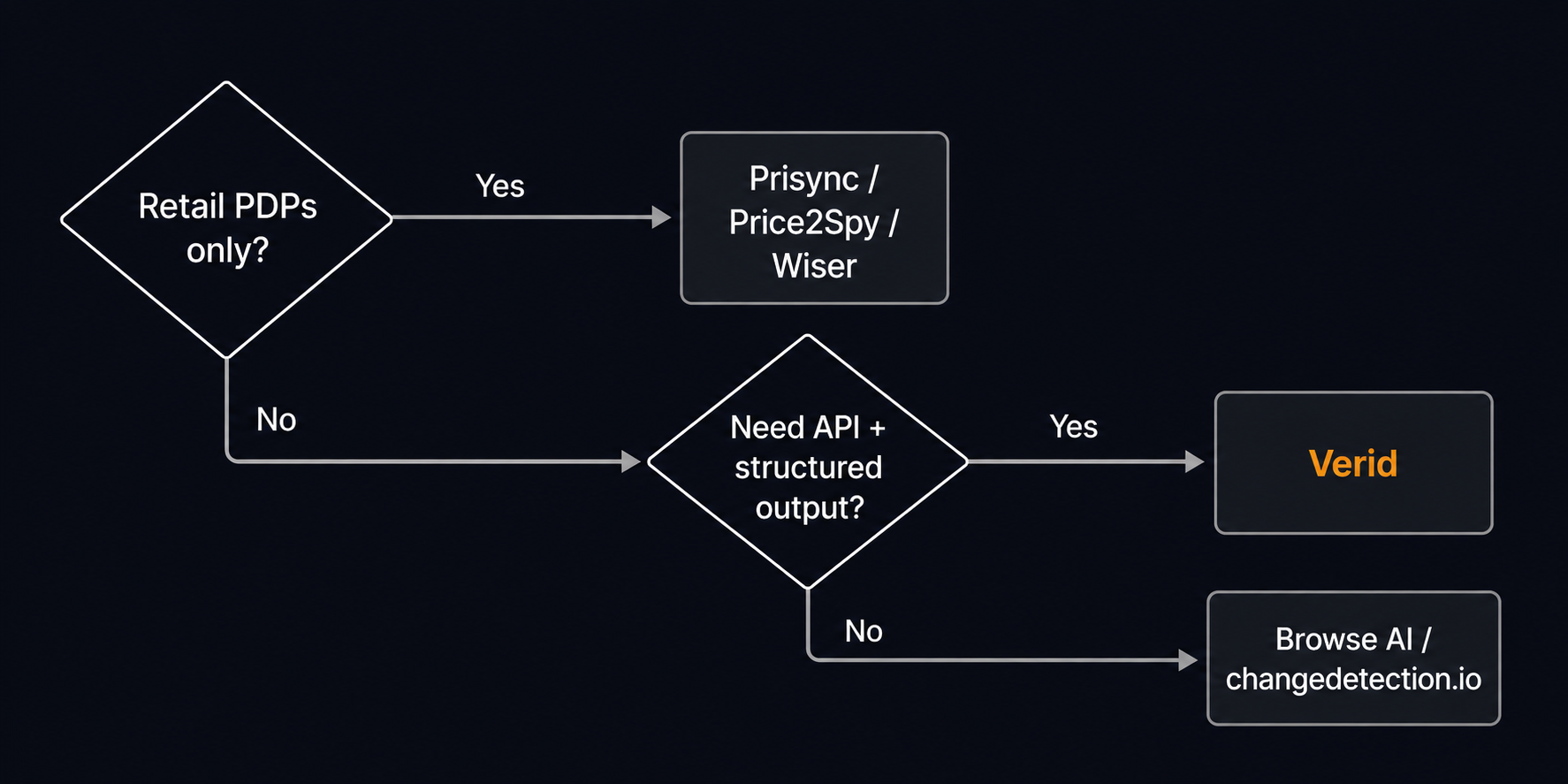
If your entire use case is tracking prices on ecommerce product pages (Amazon, Shopify, your competitors' PDPs), Prisync and Price2Spy are strong, purpose-built options. They handle the retail catalog management problem better than a general-purpose tool will.
If you need to monitor SaaS pricing pages, internal JSON APIs, competitor landing copy, or any non-retail URL, you need a general-purpose change detection tool. Verid, changedetection.io, and Browse AI all handle arbitrary URLs.
Question 2: Does the monitoring output need to plug into your own system?
If yes, you need an API-first tool with structured webhook payloads. Verid is the only option in this list that satisfies both criteria on a self-serve basis. changedetection.io has an API but the output is text diffs.
If no, the dashboard-first tools (Prisync, Price2Spy, Wiser) have better out-of-the-box reporting and alert UX for non-technical users.
Question 3: What is the scale and does self-hosting matter?
At hundreds of thousands of SKUs and enterprise budgets, Intelligence Node and Competera operate at the data infrastructure layer that Verid and changedetection.io do not target. At startup to mid-market scale (up to a few thousand monitors), Verid's Scale plan or a well-configured changedetection.io instance covers the volume.
If data sovereignty is a hard requirement, changedetection.io's self-hosted version is the only option here that lets you run entirely on your own infrastructure.
What developers specifically need from a competitor pricing platform
If you are an engineer building a competitive intelligence system, dashboards and spreadsheet exports are not the primary deliverable. Your primary deliverable is a reliable data pipeline: a structured event stream of price changes, delivered to a webhook endpoint or queryable via API, with enough metadata to feed downstream systems without additional parsing.
Most price intelligence tools in this category fail that test. They were designed for a category manager who logs into a dashboard and exports a CSV. The API was added later, usually gated behind an enterprise plan, and the webhook payloads were designed to trigger email notifications, not to drive automated workflows.
The practical consequence: if you use Prisync's API to pull price data into your own system, you are working against the tool's grain. The data model was designed for their dashboard. You are extracting it into yours.
Verid was designed in the opposite direction. The internal data model is a stream of structured change events. The dashboard is a view over that stream. The API and webhooks are the primary surface. This matters when you are building:
- A repricing engine that needs to react to competitor price drops within minutes
- A compliance system that needs an auditable log of price changes over time
- A SaaS feature that surfaces competitor intelligence to your own users
- A data pipeline that feeds price deltas into a BI tool or warehouse
For each of these, you need structured data from the monitoring layer, not a text diff you parse yourself. See the competitor ad and landing copy changes use case for how this extends beyond numeric price fields to text-based monitoring.
What growth teams specifically need
Growth teams and category managers have different constraints. Time to value is the first one: you cannot spend two weeks writing API integration code before you see your first price alert.
The tools that serve growth teams best give you a dashboard, an onboarding flow that takes minutes (not days), and alerting that works out of the box via email or Slack without configuration.
Prisync and Price2Spy are the strongest choices here for pure ecommerce catalog tracking. Their UIs are designed for category managers. You upload a competitor URL list, map it to your SKU catalog, and start seeing price position data within a day.
Verid is also viable for non-technical growth team members when the monitoring targets are arbitrary pages rather than retail catalogs. The dashboard is clean, the monitor setup takes under five minutes per URL, and the alert channels (Slack, email, webhook) are available on every plan, the free trial included. The 14-day free trial at verid.dev includes unlimited monitors and 200 runs (about 14 pages checked daily), which is enough for a growth team to test ad-hoc competitive research before committing to a paid plan from $9/month.
The gap: Verid does not have the bulk catalog management features that Prisync and Price2Spy have. If you have 500 SKUs to map against 10 competitors, Prisync's catalog import and competitor mapping UI is faster to set up than creating 5,000 individual monitors in Verid.
Frequently Asked Questions
What is the best competitor price tracking tool?
The best tool depends on your team. No-code users lean to visual tools like Visualping; e-commerce repricing teams use retail-specific platforms like Prisync or Price2Spy; developers and product teams who want field-level extraction and a signed webhook tend to pick an API-first option like Verid. Match the tool to whether you need a dashboard or an API.
How does competitor price monitoring work?
A monitor loads a competitor's product page on a schedule, extracts the price into a named field (via a CSS selector or similar), compares it against the last recorded value, and fires an alert when the number changes. With Verid that alert is a signed webhook, Slack message, or email containing the old and new price.
Is there a free competitor price tracking tool?
Verid has a 14-day free trial with unlimited monitors, 200 runs and no credit card, which is enough to test tracking a handful of competitor SKUs; after that, Lite is $9/month for 1,000 runs. Open-source changedetection.io is free if you self-host. Most dedicated retail platforms also offer only a time-limited trial.
Can I track competitor prices automatically without writing a scraper?
Yes. You point the tool at the product page, tell it which element holds the price, and set a check interval — no scraping pipeline, proxy rotation, or headless-browser cluster to maintain. The service handles fetching and rendering.
How often should I check competitor prices?
For volatile categories, every 15 minutes to hourly; for slower-moving catalogs, daily is enough. Every Verid plan, including the free trial, can check as often as every minute; plans differ by how many runs you get each month.
Start with the right tool for your use case
If you need a competitor pricing platform for a retail catalog, Prisync and Price2Spy are the best starting points. Both have free trials and onboarding teams.
If you need price intelligence tools that talk to your stack, deliver structured change events via webhook, and work on any URL, not just retail PDPs, Verid's 14-day free trial at verid.dev includes unlimited monitors and 200 runs and takes under 5 minutes to set up. No credit card. When you are ready to check more often or watch more pages, the pricing page shows what each tier covers.
If cost and data sovereignty are the only constraints and you are comfortable running Docker, changedetection.io is worth evaluating first.
About the author

Software Engineer
As a software engineer, Suleman works across Verid’s queueing, scraping and notification layers. His posts turn that day-to-day engineering into practical walkthroughs for anyone automating website change tracking.
More from Suleman →Related posts
Monitor Competitor Pricing Pages with Webhooks (Step-by-Step)
Set up a webhook receiver that fires on real price changes: verified payload, currency parsing, noise filtering, and routing to Slack or a repricing engine.
Read the post →competitor monitoringHow to Detect When a Competitor Changes Their Pricing Page Automatically
Learn how to detect competitor pricing page changes automatically using field level extraction, predicates, and webhook alerts with Verid.
Read the post →competitor monitoringBest Competitor Monitoring Tools for SaaS Companies in 2026
Compare 9 competitor monitoring tools for SaaS teams in 2026, from five-figure CI suites to API-based pricing page monitors like Verid.
Read the post →competitor intelligenceCompetitor Price Intelligence: Build a Real System
Build a competitor price intelligence system without gluing 5 tools together. Learn the full stack — scraping, diffing, alerting, storage.
Read the post →